
Schedule Your Visit
Fill out the appointment form and our team will contact you shortly.
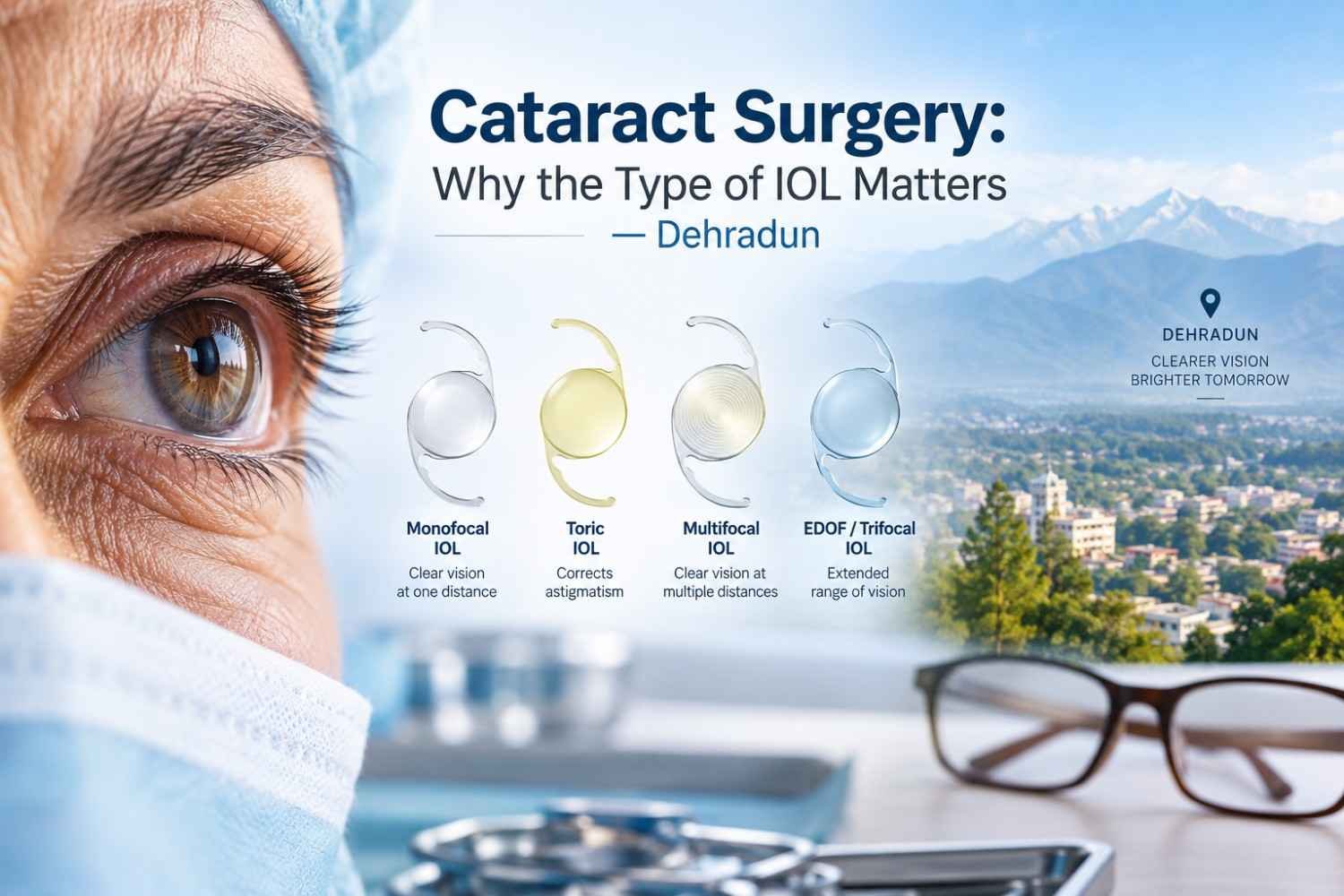
Cataract Surgery: Why the Type of IOL Matters — A Complete Guide for Patients in Dehradun
Most patients preparing for cataract surgery in Dehradun spend a great deal of time thinking about the surgery itself — how long it takes, whether it hurts, how quickly they will recover. Very few spend enough time on the decision that will determine how well they see for the rest of their lives: the choice of intraocular lens.
The IOL — the artificial lens implanted when the cloudy natural lens is removed — is permanent. Unlike spectacles that can be changed every year or contact lenses that can be swapped, an IOL stays in the eye. The visual experience it provides — how clearly you see in the distance, whether you need reading glasses, how you cope with night driving — is what you wake up to every morning for the remainder of your life.
This is why IOL selection is not a detail. It is the central clinical and personal decision of cataract surgery. And it is why the right IOL for one patient in Dehradun may be the wrong one for another — even if they have cataracts of identical severity, by the same surgeon, at the same clinic.
This guide explains every IOL type available at Raahi Netradham, what each one does, who it suits, and how Dr. Isha Agarwalla helps patients make the choice that is right for their vision, their lifestyle, and their eyes.
Planning Cataract Surgery in Dehradun? Start With an IOL Consultation
Dr. Isha Agarwalla (FAICO) | Optical Biometry | Full IOL Range | NABH Accredited | Raahi Netradham
Book Your Eye Consultation in Dehradun
Get comprehensive eye care at Raahi Netradham with fellowship specialists, advanced diagnostics, and in-house treatment facilities.
What We'll Cover
- • What an IOL is and why it is permanent
- • How IOL power is calculated — why biometry is everything
- • IOL Type 1 — Monofocal IOL
- • IOL Type 2 — Toric IOL (for astigmatism)
- • IOL Type 3 — Multifocal IOL
- • IOL Type 4 — Trifocal IOL
- • IOL Type 5 — EDOF IOL (Extended Depth of Focus)
- • The master comparison table — all IOL types side by side
- • How to choose — lifestyle-based decision guide
- • Which patients are NOT good candidates for premium IOLs
- • IOL selection at Raahi Netradham — Dr. Isha's approach
- • FAQs — answered directly
The Analogy That Makes It Clear
Think of your natural lens as a camera's zoom lens — it adjusts focus automatically for near and far. The cataract clouds the glass. Removing it restores clarity — but the replacement lens (the IOL) is a fixed optical element. It cannot zoom. So you and your surgeon choose, before surgery, which focal point or range of focus to build into that fixed lens — and that choice is permanent.
What Is an IOL — and Why Is It Permanent?
When a cataract is removed using phacoemulsification, the cloudy natural lens is broken up and aspirated through a tiny incision. The thin membrane that held the natural lens — the capsular bag — is left intact. The IOL is folded and inserted through the same incision, then unfolds inside the capsular bag, where it is held in precise centration by small haptic arms.
Over the following weeks, the capsular bag shrinks slightly around the IOL, securing it permanently. The lens is not sutured — it is held by the anatomy of the eye itself. And because the capsular bag is a biological structure that integrates around the IOL, removal is a complex surgical procedure that is only undertaken in specific circumstances.
In practical terms: the IOL you choose at surgery is the vision you will have for the rest of your life. This is not a reason for anxiety — it is a reason to have the IOL conversation properly, with the right surgeon, with enough time to ask every question you have.
How IOL Power Is Calculated — Why Biometry Is Everything
Before any IOL can be selected, the correct power must be calculated. An IOL of the wrong power leaves the patient with residual short-sightedness or long-sightedness after surgery — requiring spectacles even for distance vision, which partially defeats the purpose of the procedure.
IOL power calculation uses optical biometry — specifically the IOL Master — which measures:
- Axial length — the front-to-back length of the eyeball (the most critical measurement)
- Keratometry — the curvature of the cornea in two meridians
- Anterior chamber depth — the distance from cornea to iris
- White-to-white diameter — the visible size of the cornea
- Lens thickness — for advanced formula calculations
These measurements are entered into advanced IOL calculation formulae — Barrett Universal II, Hill-RBF, Hoffer Q, Kane — to determine the optimal IOL power for each eye. The accuracy of these measurements directly determines the accuracy of the post-operative refraction.
Why Biometry Quality Matters More Than IOL Brand
The most expensive premium IOL implanted with inaccurate biometry will give a worse result than a standard monofocal implanted with perfect biometry. At Raahi Netradham, optical biometry is performed at every pre-operative assessment — not as an optional add-on. It is the foundation on which every IOL decision is built. No IOL discussion begins before the biometry measurements are reviewed.
For toric IOLs, corneal topography is additionally performed — mapping the corneal surface to precisely determine the axis and magnitude of astigmatism that the toric IOL must correct.
Comprehensive Guide to IOL Types
Monofocal IOL
The reliable, proven standard — excellent for one focal distance.
A monofocal IOL provides clear vision at one focal distance — most commonly set for distance (infinity to approximately 6 metres). The patient sees clearly for driving, watching television, and recognising faces without glasses. For near tasks — reading, WhatsApp, a medicine bottle label, a newspaper — reading glasses are required. Monofocal IOLs are the most widely implanted IOLs worldwide, with decades of proven outcomes and the lowest rate of optical side effects of any IOL type.
Who is best suited to a monofocal IOL?- Patients who are comfortable wearing reading glasses after surgery — particularly those already accustomed to them
- Patients with significant dry eye, irregular corneas, or previous corneal refractive surgery — where premium IOLs carry higher risk of suboptimal outcomes
- Patients with macular disease, glaucoma, or other retinal conditions — where contrast sensitivity is already compromised
- Patients who prioritise the highest quality distance vision with no optical artefacts over spectacle independence
- Patients on a tighter budget for whom the premium IOL cost is a genuine constraint
Some patients choose 'monovision' — one eye set for distance and one eye set for near. This can reduce spectacle dependence significantly in patients who have previously tolerated monovision with contact lenses. It requires careful patient selection and pre-operative trialling. Dr. Isha discusses monovision as an option for appropriate candidates.
Toric IOL
The essential lens for patients with astigmatism — distance vision without the cylinder.
A toric IOL incorporates astigmatism correction directly into the lens. For patients with cylindrical spectacle prescriptions above 1 dioptre, implanting a standard monofocal or trifocal IOL without toric correction leaves the patient with residual astigmatism — blurred and distorted vision at all distances that requires glasses or contact lenses to correct. A toric IOL neutralises the astigmatism at the time of surgery, giving clear, sharp distance vision without the cylinder.
Who needs a toric IOL?Any patient with more than 1 dioptre of regular astigmatism (cylinder in spectacles) should be offered a toric IOL. The higher the astigmatism, the greater the benefit. Without toric correction:
- A patient with -2.5 dioptres of astigmatism who receives a standard monofocal will have blurred, distorted vision that requires glasses even for distance after cataract surgery
- A patient choosing a trifocal IOL without toric correction will not achieve the spectacle independence they expect — the residual astigmatism will blur all focal distances
The toric IOL has different power in two meridians — like a toric contact lens. At surgery, it must be precisely aligned to the steepest corneal meridian to neutralise the astigmatism. Dr. Isha marks the axis on the cornea before surgery using corneal topography data, and the IOL is aligned to this mark during implantation. Slight rotational misalignment reduces the astigmatism correction significantly — which is why surgeon experience and precision at implantation matters greatly for toric IOLs.
Ramesh Bisht, 63, Raipur, Dehradun: "Hamesha se chaashma lagata tha — dono aankhon mein cylinder bhi tha. Dr. Isha ne bola toric lens lagayenge — cylinder bhi theek ho jayega. Surgery ke baad pehli baar zindagi mein bina chashme ke TV dekha. Seedha saaf. Padhne ke liye abhi bhi glasses chahiye par door bilkul clear hai. Yeh toh maine socha hi nahi tha ki possible hoga."
("I had always worn glasses — with cylinder in both eyes. Dr. Isha said we'll use a toric lens — the cylinder will also be corrected. After surgery for the first time in my life I watched TV without glasses. Directly clear. I still need glasses for reading but distance is completely clear. I hadn't even thought this would be possible.")
Multifocal IOL
Two or more focal points — near and distance in one lens.
A multifocal IOL has two or more zones of different power built into the lens — most commonly a distance zone and a near zone. The brain learns to select the appropriate focal zone for the viewing distance. The result, in good candidates, is functional vision at both distance and near without glasses. The trade-off: some patients experience halos around lights at night, particularly in the early months after surgery, while the brain adapts.
Multifocal IOL — what patients experience:- Good distance vision — television, driving in daylight, outdoor activities
- Good near vision — reading, phone, menus, in good light
- Reduced spectacle dependence — most patients rarely need glasses for daily tasks
- Halos around lights at night — particularly headlights and streetlamps. Most patients adapt over 3-6 months (neuroadaptation). Some find persistent halos problematic
- Contrast sensitivity slightly reduced compared to monofocal — important consideration for patients with existing contrast sensitivity issues
- Night drivers — taxi drivers, truck drivers, those with long night commutes on the hilly roads around Dehradun
- Patients with large pupils — more susceptible to halos with multifocal optics
- Patients with macular disease, glaucoma, or corneal irregularities
- Patients with high expectations who have not been adequately counselled on halos and neuroadaptation
Trifocal IOL
Distance, intermediate and near — the gold standard for spectacle independence.
A trifocal IOL provides three focal points — distance, intermediate (computer screen, dashboard, cooking), and near (reading, phone). This covers the full range of everyday vision tasks. Modern trifocal IOLs — including the AT LISA tri, PanOptix, and other platforms — offer superior spectacle independence compared to bifocal multifocal designs, with reduced halos compared to older multifocal technology. For active, healthy patients who want maximum glasses freedom, a trifocal IOL is the premium benchmark.
Why trifocal outperforms standard multifocal for most patients:The addition of the intermediate focal point is what makes trifocal IOLs superior for modern lifestyles. A standard bifocal multifocal provides distance and near — but the intermediate range (50-70cm) — where most screen use, cooking, and face-to-face conversation happens — is blurred. Trifocal IOLs eliminate this gap, providing smooth, functional vision across the full spectrum of daily activities.
Who is ideally suited to a trifocal IOL?- Active patients who want to read, use a smartphone, work at a computer, drive, and walk — all without glasses
- Patients planning to travel, remain socially active, or continue professional work after surgery
- Patients from Mussoorie, Dehradun, Haridwar, and across Uttarakhand who want to enjoy the outdoors without reaching for spectacles
- Patients without significant dry eye, corneal disease, or macular pathology
- Patients with realistic expectations who understand neuroadaptation may take 2-3 months
"When I sit with a patient to discuss IOL options, one of the first questions I ask is: describe your perfect day — what do you do from morning to evening, and what would bother you most about needing glasses? A retired teacher who reads extensively and uses a laptop gets a different recommendation from a farmer who works outdoors and reads only occasionally. The IOL must fit the life, not the other way around."
EDOF IOL (Extended Depth of Focus)
A seamless range of vision — from distance to intermediate — with fewer optical side effects.
An EDOF (Extended Depth of Focus) IOL does not create discrete focal points like a multifocal. Instead, it elongates and extends the range of clear vision — from far distance through to intermediate — by manipulating how light is focused. The result is a smooth, continuous range of vision from 6 metres down to approximately 60-70cm, with excellent distance and very good intermediate. Near vision (below 40cm) is functional but may require low-power reading glasses in some patients. The significant advantage: EDOF IOLs produce far fewer halos and glare than standard multifocal or trifocal IOLs.
Who benefits most from an EDOF IOL?- Patients who want to reduce spectacle dependence but are concerned about night halos — particularly frequent night drivers
- Patients who spend significant time at intermediate distances — computer screens, cooking, dashboards — but read less
- Patients with mild dry eye or mild corneal irregularity where trifocal might not perform optimally
- Patients with large pupils who are at higher halo risk with standard multifocal
- Patients who want quality vision across the functional range without the full premium price of a trifocal
EDOF vs Trifocal — How to Choose
| Priority | Better Choice |
|---|---|
| Maximum spectacle independence — distance, screen AND reading | Trifocal IOL |
| Minimum night halos — important night driver or photosensitive patient | EDOF IOL |
| Excellent distance and computer — reading glasses acceptable | EDOF IOL |
| All-round daily independence — driving, phone, book | Trifocal IOL |
| Mild dry eye or borderline corneal topography | EDOF IOL (safer) |
| Young-active retired patient wanting full lifestyle freedom | Trifocal IOL |
Master Comparison Table — All IOL Types Side by Side
| IOL Type | Distance | Intermediate | Near | Halos | Glasses After? | Best For |
|---|---|---|---|---|---|---|
| Monofocal | ★★★★★ | ★★☆☆☆ | ★☆☆☆☆ | Minimal | Reading & intermediate glasses | Reliable, minimal side effects, budget-conscious |
| Toric | ★★★★★ | ★★☆☆☆ | ★☆☆☆☆ | Minimal | Reading glasses — distance clear | Patients with astigmatism (cylinder) |
| Multifocal | ★★★★☆ | ★★★☆☆ | ★★★★☆ | Moderate | Rarely for daily tasks | Moderate lifestyle, some night driving tolerance |
| Trifocal | ★★★★★ | ★★★★★ | ★★★★★ | Low-moderate | Rarely for any task | Active lifestyle, maximum independence |
| EDOF | ★★★★★ | ★★★★★ | ★★★☆☆ | Very low | Distance and screen glasses-free; low-power readers for fine print | Night drivers, screen users, halo-sensitive patients |
How to Choose — Lifestyle-Based Decision Guide
The right IOL is the one that fits the life you actually live — not the life you think you should live. Here are the most common patient profiles at Raahi Netradham and the IOL conversation that typically follows:
| Patient Profile | Typical IOL Discussion |
|---|---|
| Retired teacher, 67, Dehradun Reads 3 hours a day, uses a laptop, drives only in daylight, socially active |
Trifocal IOL — maximal spectacle independence for all daily activities including reading and screen. |
| Truck driver, 58, Rishikesh Drives 8+ hours daily including night driving on mountain roads |
Monofocal IOL for distance — halos from multifocal/trifocal would be problematic for night safety. |
| Businessperson, 62, Haridwar Computer 4 hours daily, drives in the city, occasional reading glasses acceptable |
EDOF IOL — excellent distance and screen; low-power readers only for fine print; minimal halos for city driving. |
| Homemaker, 65, Clement Town Cooking, watching TV, reading the Gita, WhatsApp on phone |
Trifocal IOL — covers all close and distance tasks without glasses; neuroadaptation counselling important. |
| Mountain trekker, 59, Mussoorie Active outdoors, photography, minimal indoor screen time |
Trifocal or EDOF — both give excellent distance. EDOF if any night driving on hill roads. |
| Diabetic patient, 70, Prem Nagar With mild macular changes on OCT |
Monofocal IOL — premium IOLs require good macular health for optimal performance; safety first. |
| Patient with -3D of astigmatism (cylinder), 64, Roorkee Wants distance glasses-free |
Toric Trifocal IOL — corrects both cataract and astigmatism while providing spectacle independence. |
Who Is NOT a Good Candidate for Premium IOLs
Premium IOLs — trifocal and EDOF in particular — deliver outstanding outcomes in the right patients. But they require specific conditions to perform well, and recommending them to unsuitable patients produces disappointed outcomes.
| Condition | Why Premium IOL Is Risky | Dr. Isha's Recommendation |
|---|---|---|
| Significant dry eye disease | Irregular tear film degrades the optical quality that premium IOLs depend on — halos worsen, vision quality reduced. | Treat dry eye aggressively first; reassess. Monofocal or EDOF in mild cases. |
| Macular disease (AMD, diabetic macular oedema, epiretinal membrane) |
Premium IOLs require good macular function. Macular disease limits contrast sensitivity — premium optics cannot compensate. | Monofocal IOL — maximise surgical safety; manage macular condition separately. |
| Irregular cornea (keratoconus, corneal scarring, post-LASIK ectasia) |
Corneal irregularity distorts the optical performance of premium IOLs unpredictably. | Monofocal IOL; corneal management first if appropriate. |
| Advanced glaucoma with significant visual field loss |
Reduced contrast sensitivity makes halos more troublesome; field loss limits the benefit of presbyopia correction. | Monofocal IOL; glaucoma stability prioritised. |
| Previous corneal refractive surgery (LASIK, PRK) |
Biometry calculations less predictable — residual error risk higher; premium IOL error less forgiving. | Discuss carefully; enhanced biometry formulae used; patient counselling on realistic expectations. |
| Very high expectations without full neuroadaptation counselling |
Patients who expect perfection on Day 1 without understanding the adaptation period tend to be dissatisfied. | Full counselling session; consider EDOF or monofocal if expectations rigid. |
IOL Selection at Raahi Netradham
Dr. Isha Agarwalla's Approach
At Raahi Netradham, no patient receives an IOL recommendation without a structured pre-operative assessment and a dedicated IOL discussion. This is not a brief conversation at the end of a consultation. It is a separate, unhurried process — because the decision is permanent.
The IOL Selection Process at Raahi Netradham
- Optical biometry (IOL Master) — performed at every pre-operative assessment, not as an optional extra
- Corneal topography — for all toric IOL candidates and for any patient with a history of refractive surgery
- Dilated retinal examination and OCT — to check macular health before recommending premium IOLs
- Dry eye assessment — tear break-up time and corneal staining; manage before surgery if significant
- Lifestyle interview — what the patient actually does in their daily life, what visual tasks matter most, whether night driving is frequent
- IOL options explanation — Dr. Isha explains all suitable IOL options in plain language, with the trade-offs for each
- Time to decide — patients are encouraged to take a day or two if needed; never pressured to choose immediately
- Second-eye planning — if both eyes need cataract surgery, the second eye's IOL is planned after the first eye's result is confirmed
💬 Dr. Isha Agarwalla — Cataract Surgeon, Raahi Netradham
"My job at the IOL consultation is not to sell a lens — it is to help the patient understand what each option gives them and what it asks of them. The patient who understands they will have some halos in the first few months, and is prepared for that, has a completely different post-operative experience from the patient who was never told. Informed patients adapt. Surprised patients are disappointed."
IOL Range Available at Raahi Netradham
| IOL Category | Available at Raahi Netradham |
|---|---|
| Monofocal IOL | ✅ Multiple platforms — hydrophilic and hydrophobic; aspheric designs |
| Toric IOL | ✅ Full cylinder range — 1D to 12D+ toric correction |
| Multifocal IOL | ✅ Available for suitable candidates |
| Trifocal IOL | ✅ AT LISA tri, PanOptix, and equivalent premium trifocal platforms |
| Toric Trifocal IOL | ✅ Combined astigmatism correction + trifocal optics |
| EDOF IOL | ✅ Symfony, Vivity, and equivalent EDOF platforms |
| Toric EDOF IOL | ✅ Astigmatism + extended depth of focus combined |
| Optical Biometry | ✅ IOL Master — in-house, every pre-operative assessment |
| Corneal Topography | ✅ In-house — essential for toric IOL axis marking |