
Schedule Your Visit
Fill out the appointment form and our team will contact you shortly.
Common Eye Problems in Children: Symptoms, Causes, and Treatment
Good vision supports almost everything a child does, from learning to read and copying from the board to playing sports and moving around safely. The common eye problems in children include refractive errors (the need for glasses), squint, lazy eye, childhood cataracts, eye infections, and blocked tear ducts. Most can be managed well, especially when found early.
The difficulty is that children rarely complain. A child with blurred vision may assume everyone sees the same way, and a child with a lazy eye may notice nothing wrong because the other eye compensates. Many problems therefore come to light only through a parent’s observation, a school screening, or an eye examination. This guide explains the main conditions, their warning signs, causes, diagnosis, and treatment.
If you are seeking pediatric eye evaluation or specialized care in Uttarakhand, the pediatric ophthalmologists and eye specialists at Raahi Netradham in Dehradun provide child-friendly diagnostic assessments and comprehensive management plans.
Concerned About Your Child's Vision? Get Expert Evaluation at Raahi Netradham
Dehradun Location | NABH Accredited | Fellowship Pediatric Specialists | Child-Friendly Vision Testing, Orthoptics & Comprehensive Care
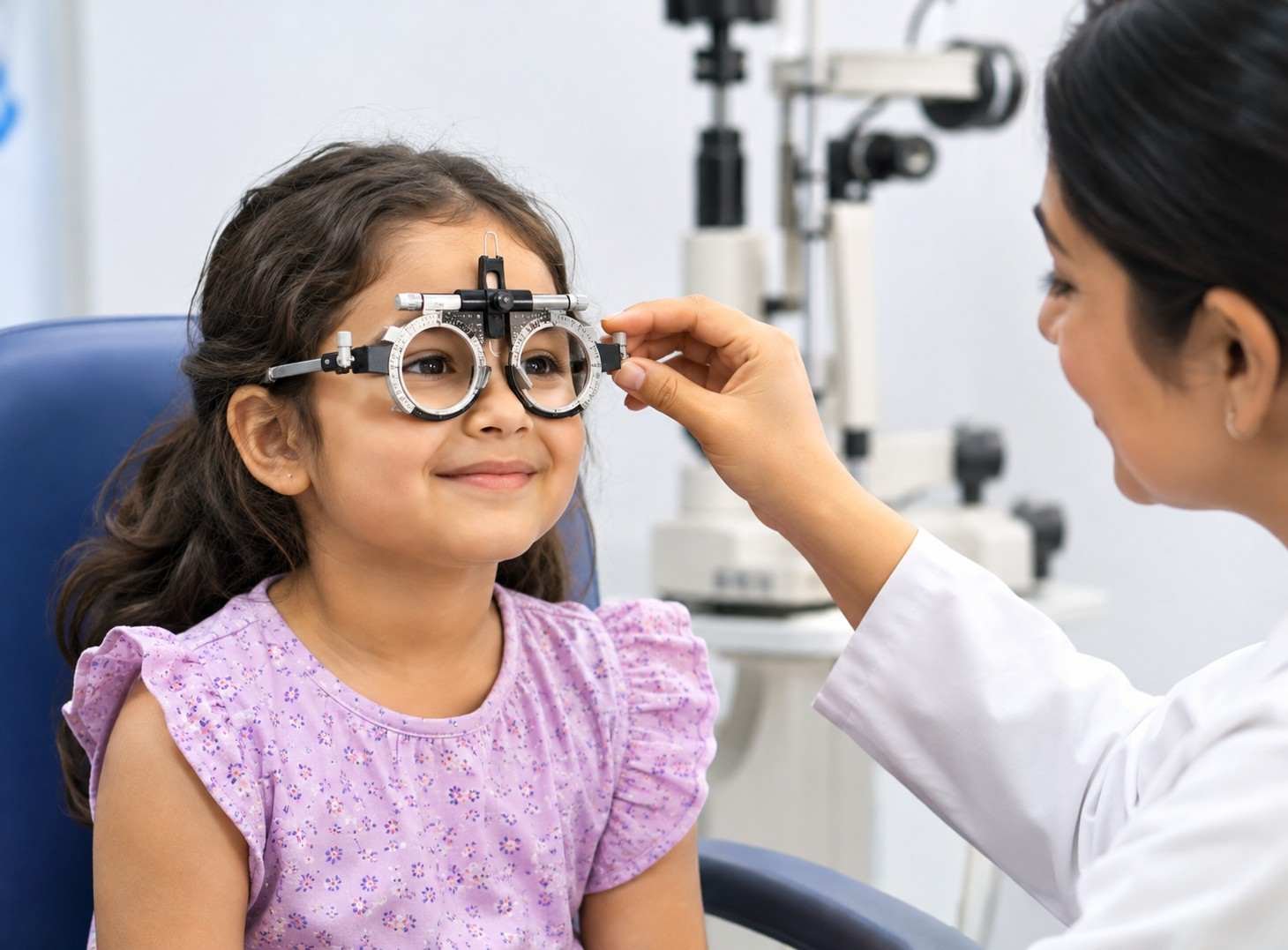
Book Your Child's Eye Consultation in Dehradun
Get comprehensive pediatric eye care at Raahi Netradham with fellowship specialists, child-friendly diagnostic tools, and complete clinical facilities.
What Causes Eye Problems in Children?
Vision develops rapidly during infancy and early childhood as the brain and eyes learn to coordinate. Eye disorders arise when optical focus, ocular alignment, structural anatomy, or neural transmission are disrupted during these critical developmental windows.
While screens are frequently blamed for every pediatric vision issue, prolonged close-up work and minimal outdoor exposure primarily contribute to myopia progression, whereas conditions like squints, amblyopia, and congenital cataracts stem from distinct anatomical and developmental factors:
- • Hereditary & Genetic Factors: Refractive errors, strabismus, and certain pediatric ocular diseases frequently run in families and influence optical development.
- • Refractive Shape Variations: Variations in corneal curvature or the axial length of the eyeball prevent incoming light from focusing directly onto the retina.
- • Muscle Coordination & Alignment Deficits: Neurological or muscular imbalances between the extraocular muscles prevent the eyes from tracking synchronously.
- • Congenital Anomalies: Structural irregularities present from birth, such as congenital cataracts, developmental glaucoma, or incomplete nasolacrimal duct opening.
- • Infections, Allergies & Trauma: Exposure to viral or bacterial pathogens, environmental allergens, or physical accidental trauma during play and sports activities.
Some conditions are present from birth, while others emerge as children reach school age. Because children rarely articulate visual deficits, early parental awareness and timely professional evaluation are vital to prevent long-term amblyopia.
Key Diagnostic Assessments for Children's Eyes
| Diagnostic Test | What the Examination Evaluates | Clinical Importance for Diagnosis |
|---|---|---|
| Visual Acuity Testing | Assesses sharpness using picture cards (LEA symbols), tumbling E charts, or standard letter charts tailored to the child's developmental age. | Identifies baseline visual deficits, tracking ability in infants, and unequal clarity between both eyes even before a child learns the alphabet. |
| Eye Alignment & Motility (Orthoptic Review) | Checks binocular coordination, extraocular muscle balance, and tracking movements in all directions of gaze. | Detects subtle, intermittent, or overt squints (strabismus) and determines whether double vision or suppression is occurring. |
| Cycloplegic Refraction | Measures true optical focus and refractive power using specialized child-safe dilating/relaxing eye drops. | Relaxes the child's strong natural focusing muscle to accurately uncover latent hyperopia, myopia, and astigmatism. |
| External Eye & Slit-Lamp Biomicroscopy | Detailed evaluation of the eyelids, cornea, conjunctiva, tear ducts, and pupil reactions to light. | Diagnoses surface infections, allergic conjunctivitis, blocked nasolacrimal ducts, corneal clouding, or abnormal pupillary reflexes. |
| Dilated Fundus & Retinal Examination | Detailed inspection of the natural lens, vitreous chamber, optic nerve head, and retina. | Rules out pediatric cataracts, optic nerve anomalies, structural lesions, and retinopathies (such as retinopathy of prematurity). |
Primary Risk Factors & Warning Behaviors for Childhood Vision Problems
Visual impairment risk increases in the presence of specific developmental, genetic, and environmental factors. Recognizing these behavioral signs helps identify when pediatric screening is essential:
Family History & Genetics
- Significantly higher risk if parents or siblings have high refractive errors or squint
- Strong genetic predisposition for childhood myopia, amblyopia, and congenital cataracts
- Warrants early baseline clinical testing even in the absence of visible symptoms
Premature Birth & Low Birth Weight
- Babies born prematurely or with low birth weight face elevated ocular risks
- Higher incidence of Retinopathy of Prematurity (ROP), strabismus, and high myopia
- Requires protocol-guided neonatal retina screening and regular follow-ups
Frequent Squinting & Distance Struggles
- Squinting eyes, closing one eye, or frowning when viewing distant objects
- Struggles to read the classroom blackboard or recognise distant faces
- Key behavioral indicator pointing toward uncorrected myopia or astigmatism
Head Tilting & Unusual Reading Posture
- Holding books, tablets, or notebooks unusually close to the face
- Tilting head to one side or turning the face to align visual axis
- Compensatory habit often masking double vision, astigmatism, or eye misalignment
Recurrent Eye Rubbing & Frontal Headaches
- Excessive rubbing of eyes during reading, homework, or visual tasks
- Frequent complaints of frontal headaches or tired eyes after school
- Typically indicates uncorrected hyperopia (farsightedness) or ocular strain
High Screen Use & Lack of Outdoor Play
- Excessive uninterrupted hours spent on digital tablets, phones, and close screens
- Insufficient natural sunlight exposure proven to accelerate axial eye elongation
- Directly correlates with early onset and rapid progression of school myopia
Having one or more risk factors or habits does not mean permanent damage is inevitable; it highlights the critical need for an age-appropriate examination to detect and correct problems while vision is actively developing.
Clinical Overview of Common Eye Problems in Children
Childhood eye conditions range from simple refractive errors requiring corrective lenses to specialized disorders needing timely intervention during visual maturation:
| Condition | Key Characteristics & Clinical Presentation |
|---|---|
| Refractive Errors (Myopia, Hyperopia, Astigmatism) | Occurs when light does not focus precisely on the retina due to eyeball shape. Myopia blurs distance, hyperopia causes visual fatigue, and astigmatism distorts sight at all ranges. Corrected with prescription spectacles. |
| Squint / Strabismus | Misalignment of the eyes where one eye turns inward, outward, upward, or downward. May be constant or intermittent; if left untreated, it disrupts stereoscopic 3D vision and can lead to lazy eye. |
| Lazy Eye / Amblyopia | Reduced vision in one or both eyes because the brain suppresses input from an eye that had blurry focus or misalignment during early development. The eye looks normal, making early screening vital. |
| Childhood / Congenital Cataracts | Clouding of the eye’s natural lens present from birth or developing later in childhood. Can cause a white/grey pupil (leukocoria) and poor visual attention; requires prompt specialist intervention to allow visual pathway development. |
| Eye Infections & Conjunctivitis | Surface inflammation causing redness, tearing, sticky discharge, and morning eyelid crusting. May be viral, bacterial (contagious), or allergic (itching and rubbing). Managed with targeted medical care. |
| Blocked Tear Ducts (Nasolacrimal Duct Obstruction) | Very common in infants due to incomplete membrane opening at the lower end of the tear drainage system. Results in continuous watery eyes and sticky mucus build-up, frequently improving with lacrimal massage. |
Strabismus (Squint) vs. Amblyopia (Lazy Eye)
Understanding the key clinical differences, mechanisms, and treatment goals between eye misalignment and reduced neural vision:
| Feature | Squint (Strabismus) | Lazy Eye (Amblyopia) |
|---|---|---|
| Core Definition | Physical misalignment where the two eyes point in different directions | Neural vision deficit where the brain ignores or suppresses visual input from one eye |
| Visible Appearance | Easily observable deviation (eye turning inward, outward, or vertically) | The eye usually looks completely normal, healthy, and straight |
| Primary Causes | Uncorrected refractive error, extraocular muscle imbalance, or nerve coordination failure | Untreated squint, unequal refractive error between eyes (anisometropia), or visual blockage (cataract/ptosis) |
| Primary Treatment Approach | Corrective glasses, orthoptic therapy, prism lenses, or muscle realignment surgery | Treating the underlying cause, followed by occlusion therapy (patching) or blurring drops for the stronger eye |
What Are the Treatment Options for Childhood Eye Problems?
Treatment depends entirely on the underlying diagnosis. Not every condition requires surgery; timely non-invasive interventions often preserve and restore normal visual development.
Prescription Spectacles
The primary therapy for myopia, hyperopia, and astigmatism. Corrective glasses focus light precisely on the retina and often serve as the essential first step in straightening accommodative squints.
Amblyopia Occlusion (Patching)
Patching the stronger eye for designated daily intervals stimulates neural pathways from the weaker eye to the brain, restoring balanced visual acuity when performed during early childhood.
Squint & Cataract Surgery
Microsurgical interventions rebalance eye muscles to restore alignment in strabismus, or remove cloudy lenses with intraocular lens implantation in childhood cataracts when vision is threatened.
Conservative Care & Probing
Gentle nasolacrimal sac massage resolves most infant tear duct blocks; persistent cases are treated with gentle duct probing. Surface infections and allergies are treated with specialized pediatric drops.
How Can Parents Protect Their Children’s Eye Health?
While genetics and congenital issues cannot be prevented, daily proactive habits safeguard children against progressive myopia, ocular fatigue, and traumatic eye injuries.
Daily Outdoor Play
Encourage 1-2 hours of daily outdoor activity in natural daylight, which triggers retinal dopamine release and has been clinically proven to slow myopia progression.
Smart Screen Limits (20-20-20 Rule)
Set reasonable screen limits and encourage children to take a 20-second break every 20 minutes by looking at something 20 feet away to relax focusing muscles.
Injury & Hygiene Safeguards
Provide certified sports eyewear, keep pointed objects and fireworks away, teach consistent hand-washing, and avoid self-medicating with leftover steroid drops.
When Should You Take Your Child to an Eye Specialist?
Understanding the boundary between routine developmental assessments and urgent situations ensures vision is preserved for life.
Routine Clinical Assessments
Schedule an evaluation if you notice persistent squinting, frequent head tilting, schoolwork complaints, chronic eye rubbing, or if there is a family history of childhood eye conditions.
Immediate Emergency Situations
A white or abnormal pupil reflex (seen in flash photos), sudden vision deterioration, severe eye pain, foreign body penetration, or chemical exposure demands immediate emergency evaluation.
Warning Signs of Pediatric Eye Problems & Emergencies
When to Seek Immediate Pediatric Ophthalmology Care
Contact a pediatric ophthalmologist immediately or visit the nearest emergency eye service if you observe:
Frequently Asked Questions About Children's Eye Problems
Pediatric Eye Care in Dehradun at Raahi Netradham
Children’s eyes are continuously developing, which means vision concerns require careful assessment by experienced eye care professionals equipped with child-friendly diagnostic tools. Raahi Netradham is an eye hospital in Dehradun, Uttarakhand, providing comprehensive pediatric ophthalmology and orthoptic services tailored to infants, young children, and teenagers.
The hospital’s pediatric eye care services encompass comprehensive childhood vision examinations, management of refractive errors, squint correction, amblyopia occlusion therapy, and treatment for pediatric cataracts and congenital glaucoma. Early detection during visual development is the most effective way to safeguard lifelong sight.
To arrange a consultation for your child, you can book an appointment online or contact the hospital directly at +91 7078082666. The hospital is open Monday to Saturday, 9 AM to 6 PM (closed on Sundays). If your child experiences an acute eye injury, sudden sight reduction, or severe pain, seek immediate emergency eye care.
Medical disclaimer: This article is for general educational purposes only and does not replace professional medical advice, diagnosis, or treatment. Pediatric vision conditions require direct evaluation by a qualified ophthalmologist. Never administer prescription or leftover eye drops to a child without clinical direction.