
Schedule Your Visit
Fill out the appointment form and our team will contact you shortly.
Monofocal vs EDOF Lens: Which Is the Right Cataract Lens for You?
When cataract surgery is scheduled, most patients assume the main decision is when to have it done and where to go. The decision that will actually shape their daily experience for the rest of their lives — which lens goes into the eye — often receives far less thought.
The intraocular lens (IOL) implanted during cataract surgery is permanent. It determines whether you reach for your reading glasses after surgery, whether you can see your phone without squinting, whether night driving feels comfortable, and how much visual freedom your daily life contains.
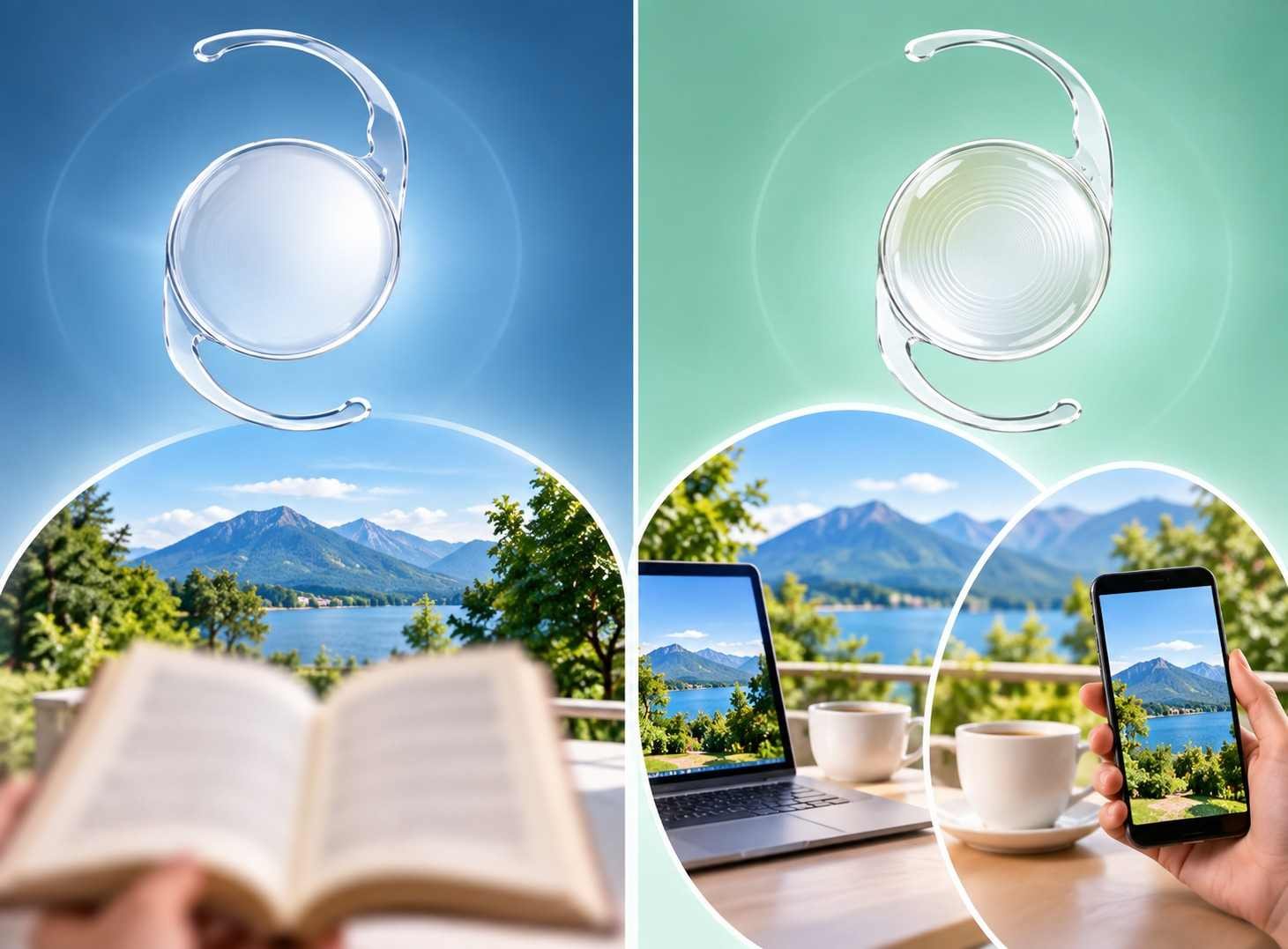
Two of the most commonly compared lens types for cataract surgery are the monofocal IOL and the EDOF (Extended Depth of Focus) IOL. They are genuinely different — in how they work, in what they give you, and in who they suit. Understanding that difference, clearly and honestly, is what this guide is for.
Planning Cataract Surgery in Dehradun? Start With an IOL Consultation.
Dr. Isha Agarwalla (FAICO) | Optical Biometry | Full IOL Range | NABH Accredited | Raahi Netradham
Book Your Eye Consultation in Dehradun
Get comprehensive eye care at Raahi Netradham with fellowship specialists, advanced diagnostics, and in-house treatment facilities.
What This Guide Covers
- What each lens actually does — the optics explained simply
- What you can and cannot see with a monofocal lens
- What you can and cannot see with an EDOF lens
- The side-by-side master comparison
- Which daily activities each lens serves best
- Who should choose monofocal — and who should choose EDOF
- What about trifocal — when is that the better choice instead?
- How the decision is made at Raahi Netradham
- FAQs — answered directly
How Each Lens Works — The Optics, Simply Explained
Before comparing what each lens gives you in daily life, it helps to understand — at the most basic level — how each one works optically. You do not need to understand refraction physics. You need to understand what is happening inside your eye.
The Natural Lens — What You Are Replacing
Your eye's natural crystalline lens is a flexible, dynamic structure. In a young eye, it changes shape continuously — curving to focus on near objects and flattening to focus on distant ones. This process, called accommodation, is what lets a 20-year-old read a book one moment and look across a room the next without reaching for glasses.
By the time a cataract develops — typically in the 60s and 70s — the lens has long since lost most of this flexibility. Most cataract patients already need reading glasses before their surgery. The cataract is not what caused the loss of near focus — presbyopia (age-related near vision loss) did. But replacing the cloudy lens with an IOL is the one opportunity in a person's life to choose what kind of focus they want to build in permanently.
The Monofocal IOL — One Fixed Point
A monofocal IOL has a single, fixed focal point built into the lens. When light enters the eye, the lens focuses it precisely at one distance — most commonly set for infinity (6 metres and beyond). The result is that objects at that distance are in sharp, clear focus without glasses.
Objects closer than the set focal point — a book, a phone screen, a dashboard — are not in focus without glasses. The brain cannot compensate for the fixed focal distance. Reading glasses are not a failure of the surgery; they are the expected, designed reality of a monofocal lens.
Monofocal IOL — The Camera with a Fixed Prime Lens
Think of a monofocal IOL as a camera fitted with a single fixed focal length lens — like a 50mm prime. It takes exquisitely sharp photographs at one distance. Move closer or further away and the image goes soft. For everyday photography at that one distance, it is outstanding. For everything else, you need to zoom — or in the case of your eye, put on glasses.
The EDOF IOL — A Continuous Range
An EDOF (Extended Depth of Focus) IOL works differently. Instead of creating one sharp focal point, it extends and elongates the range of clear focus — stretching the zone of good vision from far distance continuously through to intermediate. The technology varies by brand — some use diffractive rings, some use a refractive pinhole effect, some use chromatic aberration manipulation — but the goal is the same: a smooth, uninterrupted range of clear vision across a broader depth of field than a monofocal.
The visual result is that an EDOF patient sees clearly for driving, watching television, having a conversation, using a computer, reading a dashboard, and cooking — all without glasses. Near vision (below 40-50cm) is functional but softer, and may benefit from a low-power reader for sustained fine-print tasks.
EDOF IOL — The Camera with a Deep Depth of Field
Think of an EDOF IOL as a camera with a small aperture and deep depth of field — everything from 1 metre to infinity is acceptably sharp in the same frame. You do not need to refocus for each distance. The trade-off: very close subjects (within 40cm) are still slightly soft — you might need to step back to see them clearly, or use a magnifying glass for very fine detail.
The Monofocal IOL — What You See, What You Do Not
Monofocal IOL
The reliable standard — excellent for one distance, glasses needed for the rest
A monofocal IOL is the most widely implanted cataract lens in the world. Decades of clinical experience, outstanding distance optical quality, minimal side effects, and no neuroadaptation required make it the default — and often the best — choice for many patients.
What a monofocal patient typically sees clearly without glasses
- Faces across a room and beyond — distance recognition
- Television and cinema — at typical viewing distances of 3-5 metres
- Driving — road signs, traffic, the road ahead — in daylight and at night
- Walking outdoors — the hill path, the Mussoorie landscape, the mountain range
- Theatre, cinema, cricket ground — any large-scale distant experience
What a monofocal patient typically needs glasses for
- Reading a book, newspaper, or magazine
- Reading a phone screen — WhatsApp, text messages, photos
- Computer screen and laptop work — at standard desk distance
- Dashboard instruments while driving
- Reading menus, price tags, medicine bottle labels
- Any near task in low light — bedside reading, dimly lit restaurants
The strengths of monofocal
- Highest optical quality and contrast sensitivity — images at the focal distance are supremely sharp
- No halos, no glare, no optical artefacts — completely clean visual experience
- No neuroadaptation required — vision is stable from the early days after surgery
- Excellent performance in all lighting conditions including at night
- Suitable for patients with dry eye, macular pathology, glaucoma, or irregular corneas — conditions that make premium IOLs less appropriate
- The least expensive IOL option — appropriate where budget is a genuine constraint
The limitation of monofocal
The limitation is structural — not a flaw of the lens but a design reality. A monofocal IOL was not designed to provide vision at multiple distances. A patient who wants to be glasses-free at the computer, for reading, and for driving simultaneously cannot achieve this with a monofocal lens alone. That patient needs a premium lens.
💬 Real Patient Story — Dehradun
Suresh Agarwal, 72, Haridwar: "Main doctor hoon, aur mujhe raat ko padna padta hai — case notes, prescriptions. Dr. Isha ne bola ki mere ek aankhon mein retinal problem bhi hai. Unhone bola trifocal mere liye theek nahi, monofocal better hai. Aaj door ekdum clear dikhta hai, aur padhne wali glasses toh hain hi. Main unse khush hoon — unhone mujhe wo nahi diya jo main chahta tha, diya jo mere liye sahi tha."
("I am a doctor and I need to read at night — case notes, prescriptions. Dr. Isha said one of my eyes also has a retinal problem. She said trifocal is not right for me, monofocal is better. Today distance is completely clear, and I do have reading glasses. I am happy with her — she did not give me what I wanted, she gave me what was right for me.")
The EDOF IOL — What You See, What You Do Not
EDOF IOL (Extended Depth of Focus)
The smooth range — distance to intermediate, fewer halos, less reading glasses
EDOF IOLs represent the middle ground between a monofocal lens (one sharp distance) and a trifocal lens (three distinct focal zones). They deliver a continuous, seamless range of clear vision from the far distance through to the intermediate — covering most of what an active adult does in daily life — with significantly fewer optical side effects than older multifocal designs.
What an EDOF patient typically sees clearly without glasses
- Distance vision — driving, outdoor activity, recognising faces — excellent
- Computer screen and laptop — at 50-70cm — very good to excellent
- Smartphone — at arm's length — functional to good
- Television — distance viewing — excellent
- Cooking — reading the hob, handling utensils, reading the cooker display
- Supermarket — navigating aisles, reading larger price displays
- Face-to-face conversation — near distance social interaction
- Dashboard while driving — instrument panel, GPS screen
What an EDOF patient may still benefit from glasses for
- Very fine print in low light — medicine bottle labels, small-font books, printed receipts
- Sustained reading for long periods — some patients prefer a low-power (+1.0 to +1.5D) reader for extended book reading
- Sewing, needlework, or very close detail work below 30cm
The strengths of EDOF
- No 'jump' between focal zones — the vision range is seamless and natural-feeling
- Significantly fewer halos than standard multifocal or trifocal IOLs — important for night drivers
- Covers the full range of modern daily visual demands — screens, driving, face-to-face
- Excellent contrast sensitivity — better than multifocal; approaching monofocal quality
- Good performance for patients with mild dry eye where trifocal may not deliver optimal quality
- Most patients need reading glasses rarely rather than constantly
The limitation of EDOF
An EDOF lens does not deliver the same near vision quality as a trifocal. Patients whose near vision is their highest priority — who read extensively, do detailed craft work, or work with fine text at close range for hours each day — will find trifocal delivers better near performance. EDOF is the right compromise for patients who want screen and driving freedom with minimal halos; it is not the answer for patients whose primary goal is reading-glasses freedom.
Real Patient Story — Dehradun
Priya Sharma, 59, Rajpur Road, Dehradun: "Main graphic designer hoon — computer pe 6-7 ghante kaam karti hoon. Dr. Isha se pucha ki konsa lens theek rahega. Unhone bola EDOF — screen ke liye bahut achha hai, halos bhi trifocal se kam. Ab computer bina chashme ke dekh sakti hoon. Book padhne ke liye low-power glasses lagati hoon — ek nahi, main uss se khush hoon. Computer freedom zyada important tha."
("I am a graphic designer — I work 6-7 hours on the computer. I asked Dr. Isha which lens would work. She said EDOF — very good for screens, and fewer halos than trifocal. Now I can see the computer without glasses. For reading books I use low-power glasses — just one pair, and I am happy with that. Computer freedom was more important.")
Master Comparison — Monofocal vs EDOF at a Glance
| Feature | Monofocal IOL | EDOF IOL |
|---|---|---|
| How it works | Single fixed focal point — usually distance | Continuous elongated range — distance to intermediate |
| Distance vision | ★★★★★ Excellent | ★★★★★ Excellent |
| Intermediate (50-70cm screen) | ★★☆☆☆ Blurred — glasses needed | ★★★★★ Excellent — usually glasses-free |
| Near vision (30-40cm reading) | ★☆☆☆☆ Blurred — reading glasses needed | ★★★☆☆ Functional — low readers sometimes helpful |
| Halos at night | None — completely clean optics | Mild — significantly less than trifocal |
| Contrast sensitivity | ★★★★★ Highest of all IOL types | ★★★★☆ Very good — approaching monofocal |
| Neuroadaptation needed | None — stable from first days | Minimal — most patients adapt within weeks |
| Glasses needed after | Reading + computer glasses | Low-power readers for fine print only |
| Best for: daily activities | Distance — outdoor, driving, television | Distance + screens + conversations — without glasses |
| Not ideal for | Patients who want screen freedom | Patients who cannot tolerate any halos or who read extensively |
| Suitable for dry eye? | ✅ Yes — monofocal recommended | ⚠️ Mild dry eye only — treat first |
| Suitable for macular disease? | ✅ Yes — preferred choice | ❌ No — macular health required for EDOF to perform well |
| Night driver suitability | ★★★★★ Best — no halos | ★★★★☆ Good — fewer halos than trifocal |
| Spectacle independence | Low — glasses for near + intermediate | Medium-High — glasses only for fine print |
| Cost (relative) | Standard | Premium — higher than monofocal |
★★★★★ = Excellent | ★★★★☆ = Very Good | ★★★☆☆ = Good | ★★☆☆☆ = Fair | ★☆☆☆☆ = Poor/Requires Glasses
Which Lens Serves Each Daily Activity Better?
| Daily Activity | Monofocal | EDOF | Verdict |
|---|---|---|---|
| Driving in daylight | Glasses-free ✅ | Glasses-free ✅ | Both equal |
| Driving at night | No halos ✅✅ | Mild halos initially | Monofocal safer for frequent night drivers |
| Watching television | Glasses-free ✅ | Glasses-free ✅ | Both equal |
| Smartphone use | Reading glasses needed | Usually glasses-free ✅ | EDOF better |
| Computer / laptop work | Glasses needed | Usually glasses-free ✅ | EDOF better |
| Cooking — reading labels | Glasses for small text | Functional — most labels readable ✅ | EDOF better |
| Reading a book / newspaper | Reading glasses needed | Low reader helpful | Both need glasses — EDOF needs lighter ones |
| Outdoor walking / trekking | Excellent ✅ | Excellent ✅ | Both equal |
| Face-to-face conversation | Clear ✅ | Clear ✅ | Both equal |
| Supermarket — larger labels | Glasses needed | Usually readable ✅ | EDOF better |
| Needlework / close detail | Reading glasses needed | Reading glasses needed | Both similar |
| Dashboard instruments | Glasses needed | Usually readable ✅ | EDOF better |
Who Should Choose Monofocal — and Who Should Choose EDOF
Choose Monofocal IOL if you:
- Are comfortable wearing reading glasses and do not find them inconvenient
- Drive extensively at night — particularly on dark or winding roads around Dehradun, Mussoorie, or the hill routes
- Have significant dry eye disease — unstable tear film degrades premium IOL performance
- Have macular disease — diabetic maculopathy, age-related macular degeneration, or epiretinal membrane — that limits the visual quality EDOF can deliver
- Have advanced glaucoma with reduced contrast sensitivity
- Have had previous corneal refractive surgery (LASIK/PRK) and biometry is less predictable
- Prioritise the absolute highest optical quality at distance with no trade-offs whatsoever
- Have a tighter budget and the premium IOL cost is a genuine constraint
Choose EDOF IOL if you:
- Want to drive, use a computer, and handle a smartphone without glasses — your dominant daily activities
- Are a professional or retiree whose life involves significant screen time
- Drive at night occasionally but not extensively — and can manage mild initial halos
- Are comfortable with the possibility of needing a low-power reader (+1.0 to +1.5D) for sustained fine-print reading
- Have healthy maculae (confirmed on OCT), regular corneas, and controlled or no dry eye
- Want significantly fewer halos than a trifocal lens offers
- Are prepared for a 2-4 week settling-in period while your visual system adapts
What About Trifocal — When Is That the Better Choice?
A trifocal IOL adds a third focal zone — near (30-40cm) — to the distance and intermediate zones that EDOF provides. For patients who strongly want to read without glasses as well as use screens and drive, trifocal gives better near performance than EDOF.
| Your Priority | Better Lens |
|---|---|
| Distance + screen freedom with fewest halos | EDOF IOL |
| Distance + screen + reading all without glasses | Trifocal IOL |
| Maximum visual quality, no adaptation, happy with glasses for near + screen | Monofocal IOL |
| Night driving + screen freedom, reading glasses acceptable | EDOF IOL |
| Active social life — reading menus, WhatsApp, driving, faces — all glasses-free | Trifocal IOL |
| Patient with mild dry eye wanting some independence | EDOF IOL (treat dry eye first) |
| Patient with macular disease or advanced glaucoma | Monofocal IOL |
Meet Our Expert Team of Doctors
Our reputation as the best eye hospital in Dehradun is built on our skilled professionals. Each eye doctor in Dehradun at Raahi Netradham delivers specialized expertise in priority areas like cataracts, retina, oculoplasty, and ocular tumors.

MBBS, DNB, FAICO, MNAMS – Compassionate ophthalmologist in Dehradun specializing in cataract, oculoplasty, and ocular oncology, including cosmetic.

MBBS, DNB, FVRS, MNAMS – Our leading retina specialist in Dehradun and neuro-ophthalmology expert, proficient in vitreo-retinal surgeries and cataract procedures.
MBBS, DNB, FICO, FMRF – Renowned specialist for advanced medical and surgical retina care, uveitis, and complex anterior segment surgeries.