
Schedule Your Visit
Fill out the appointment form and our team will contact you shortly.
Phaco vs SICS vs Laser Cataract Surgery: Which Is Right for You?
A neighbour says she had 'the laser operation'. Your cousin had 'phaco'. The man next door was told he needs 'SICS' because his cataract is too hard. They all sound different — and when it is your own turn, the natural question is: which one should I have, and which is best?
The honest answer is that the question itself is slightly off. There is no single best cataract operation. There is the operation that suits your particular eye. This guide explains how each technique works, what each does well, who it suits, and the myths that confuse patients in Dehradun and across Uttarakhand — so you can ask your surgeon informed questions.
The surgical complexity, operative equipment, and intraocular lens technology differ across approaches, which directly impacts recovery and visual goals. At Raahi Netradham in Dehradun, fellowship-trained cataract surgeons provide comprehensive examinations and optical biometry to determine the safest and most effective technique for your unique eye anatomy.
Not Sure Which Technique Suits Your Eye? Consult Raahi Netradham
Dehradun Location | NABH Accredited | Fellowship Cataract Surgeon | Dr. Isha Agarwalla (FAICO) | Examination + Clear Explanation of Your Options | Modern Phaco, SICS & Premium IOL Planning
Book Your Cataract Consultation in Dehradun
Get personalized clinical assessment and honest surgical guidance at Raahi Netradham with experienced cataract surgeons and advanced surgical platforms.
What All Three Cataract Techniques Have in Common
Before comparing the differences, it helps to see how much is fundamentally shared. Regardless of whether Phaco, SICS, or Laser-Assisted surgery is selected, modern cataract surgery adheres to high-precision surgical principles designed for safety, comfort, and rapid visual restoration.
Across all three approaches, you can count on the following standard clinical realities:
- • Intraocular Lens Placement: The cloudy natural crystalline lens is removed and an artificial intraocular lens (IOL) is implanted during the exact same sitting.
- • Day-Care Procedure: The surgery is performed as a day-care admission under local or topical anaesthetic drops, meaning no overnight hospital stay is required.
- • Self-Sealing Incisions: Incisions are specifically engineered to be self-sealing and stitchless, avoiding the need for conventional corneal sutures in routine cases.
- • Sequential Scheduling: To protect vision and ensure monitored recovery, both eyes are operated on separate days with an appropriate healing interval.
- • Precision Pre-Op Biometry: High-precision optical measurements and keratometry accurately calculate the required corrective power of your implanted lens.
The differences between techniques lie in how the cataractous lens is fragmented and removed, the architectural size of the incision, and the specialized theatre equipment required.
Deep Dive: Understanding the Three Primary Surgical Techniques
| Surgical Technique | Procedural Steps & Mechanism | Clinical Strengths & Considerations |
|---|---|---|
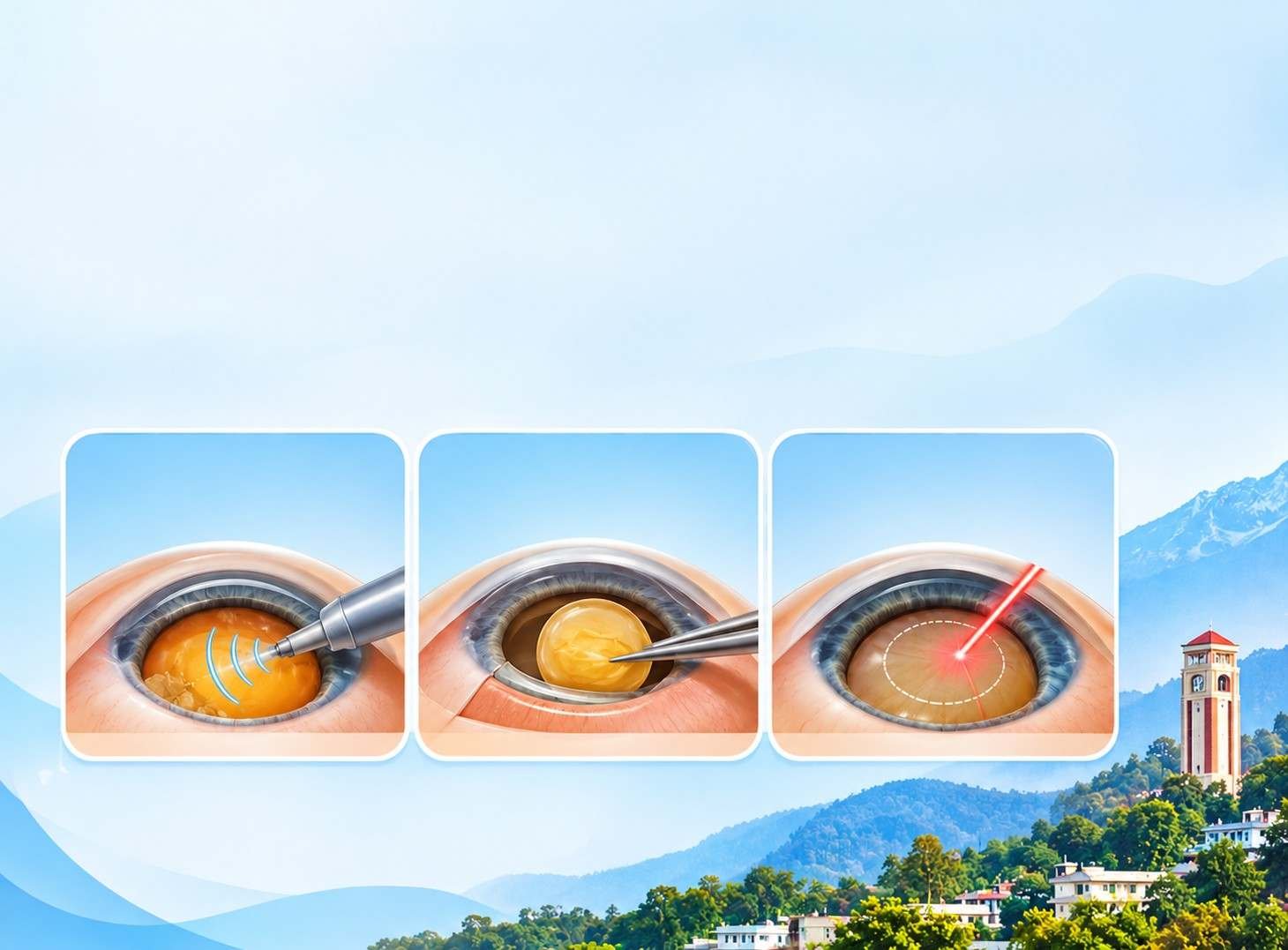
| 1. Phacoemulsification (Phaco) | A micro-incision (2.0–2.8 mm) is created at the corneal margin. A circular capsulotomy is fashioned, and a specialized ultrasound probe liquefies the lens nucleus before aspirating the fragments. A foldable IOL is then injected through the small cut. | Gold standard for routine cataracts. Extremely fast visual recovery, self-sealing wound, and tight astigmatism control essential for premium toric, EDOF, or trifocal lenses. Relies on advanced platforms like Oertli CataRhex and Faros. |
| 2. Small Incision Cataract Surgery (SICS) | A self-sealing sclero-corneal tunnel (approx. 6 mm) is fashioned through the white of the eye. Following capsulotomy, the dense, hardened lens nucleus is hydro-expressed and delivered whole by hand without ultrasound energy, followed by IOL placement. | Outstanding choice for rock-hard, hyper-mature, or brunescent cataracts where excessive ultrasound could damage corneal endothelial cells. Highly dependable and cost-effective, though larger incisions require careful astigmatism evaluation. |
| 3. Femtosecond Laser-Assisted Surgery (FLACS) | A computer-guided femtosecond laser performs clear corneal incisions, creates a pristine circular capsulorhexis, and pre-softens/fragments the cataract into quadrants. Phacoemulsification is then used to aspirate fragments and seat the IOL. | Laser does not remove the cataract—it assists the first steps. Excellent for ensuring perfectly centered capsulotomy for premium lenses and lowering ultrasound requirements. Carries higher equipment charges and requires steady patient positioning. |
| 4. Premium Lens Integration | Advanced lenses—including Toric (astigmatism correction), EDOF, and Trifocal designs—require micro-architectural wound stability and centered capsular overlap to achieve designed focal planes. | Phacoemulsification (with or without laser assistance) is the standard prerequisite for premium lenses. Selecting SICS usually limits options to standard monofocal IOLs. |
| 5. Operative Safety & Equipment | Modern operating suites employ sophisticated fluidics and laminar air flow. Harder cataracts necessitate tailored fluidics to preserve corneal clarity, while manual extraction avoids ultrasound entirely. | Safety stems from matching the technique to cataract density rather than relying on equipment labels. Experienced surgeon judgement is the deciding clinical factor. |
| 6. Healing Timelines & Follow-Up | Mild foreign body sensation or grittiness is common initially across all options. Anti-inflammatory and antibiotic drops are tapered over 4 weeks, with periodic visual checks. | Phaco patients often experience functional clarity within 24–48 hours; SICS eyes settle steadily over 1–2 weeks with spectacle refraction finalized by week 4–6. |
What to Ask Before Choosing Your Cataract Technique
Ensure complete clarity regarding your clinical indications, surgical equipment, and lens compatibility before scheduling:
Technique Justification
- Which specific technique do you recommend for my eye, and why?
- Is my cataract categorized as soft, moderately hard, or advanced/mature?
- Would choosing an alternative method compromise my recovery or corneal safety?
Lens Compatibility & Goals
- If I desire a Toric, EDOF, or Trifocal lens, which technique is clinically required?
- Can my pre-existing corneal astigmatism be neutralized through this incision size?
- Will my chosen technique allow spectacle independence for reading and screens?
Laser Role & Clinical Value
- Is femtosecond laser-assisted surgery clinically beneficial for my eye condition?
- Does my pupil dilation or corneal clarity support safe laser docking?
- How much ultrasound energy reduction does the laser step actually offer in my case?
Intraoperative Contingencies
- What clinical findings during surgery might cause you to modify the planned approach?
- Are surgical adjuncts like iris hooks or capsular tension rings on standby if needed?
- How are zonular weakness or pseudoexfoliation addressed during the procedure?
Post-Operative Recovery Plan
- What is the expected visual recovery timeline for my specific surgical method?
- How many scheduled post-op review visits are included after surgery?
- When will spectacle prescription testing be performed to finalize near or distance vision?
Transparent Package Terms
- Does the hospital provide a written cost breakdown itemizing technique, consumables, and IOL?
- Does my health insurance policy cover the recommended surgical technique and lens?
- Are emergency contact protocols and aftercare medications provided in writing at discharge?
Always ask for a transparent consultation listing the clinical rationale, incision method, and intraocular lens options before finalizing your surgical date.
Side-by-Side Comparison of Cataract Surgical Techniques
Each surgical method offers unique technical attributes. The right choice is guided by clinical measurements, lens density, and visual goals:
| Feature | Phacoemulsification | Small Incision (SICS) | Laser-Assisted (FLACS) |
|---|---|---|---|
| Incision Size | Micro-incision (about 2.0–2.8 mm) | Self-sealing tunnel (about 6.0 mm) | About 2.0–2.8 mm (laser-created) |
| Lens Removal Method | Ultrasound liquefies lens; suctioned out | Whole nucleus hydro-expressed by hand | Laser softens/divides; phaco aspirates |
| Ultrasound Energy | Yes (calibrated to cataract hardness) | None used during nucleus delivery | Yes (often reduced energy required) |
| Clinical Indication | Routine to moderately dense cataracts | Very dense, brown, or hyper-mature cataracts | Selected eyes and premium lens cases |
| Suture Requirement | Usually none (self-sealing) | Usually none (valved tunnel) | Usually none (self-sealing) |
| Visual Recovery | Generally quickest (often 24–48 hours) | Good; settles steadily over 1–2 weeks | Similar to standard phacoemulsification |
| Astigmatism Control | High precision; minimal induced cylinder | Higher potential for induced astigmatism | High precision corneal incisions |
| Premium IOL Suitability | Standard pathway for Toric, EDOF, Trifocal | Not standard; primarily monofocal IOLs | Optimal for precise capsular overlap |
| Operating Equipment | Advanced phaco system (e.g., Oertli platforms) | Specialized manual microsurgical instruments | Femtosecond laser system plus phaco machine |
| Cost Structure | Standard to premium based on lens model | Most economical and accessible | Higher tier due to laser licensing and interfaces |
Common Myths vs. Clinical Facts About Cataract Surgery
Separating patient misconceptions from verified ophthalmic science:
| Topic Area | The Prevailing Myth | The Clinical Reality |
|---|---|---|
| Laser Safety Claims | "Laser cataract surgery is completely bladeless, knifeless, and risk-free." | The laser performs only initial steps; phaco is still required to aspirate the lens. All eye surgeries carry clinical risks, and laser does not eliminate them. |
| Phaco vs. Laser Confusion | "Phacoemulsification and laser cataract surgery are the exact same thing." | Phaco uses ultrasonic energy to break the lens. Laser-assisted surgery incorporates a femtosecond laser to pre-treat incisions and capsulotomy before phaco. |
| Clinical Value of SICS | "SICS is an outdated, second-rate operation that should always be avoided." | SICS remains a world-recognized, highly dependable technique. For rock-hard, hyper-mature cataracts, it is often far safer for the cornea than high-energy ultrasound. |
| Incision Size Superiority | "The smallest incision size automatically guarantees the best visual outcome." | While small incisions aid rapid recovery, overall visual success depends far more on optical biometry accuracy, retinal health, and surgeon skill than wound size alone. |
| Sutures in Manual Surgery | "SICS always requires stitches that cause persistent irritation and pain." | SICS utilizes a self-sealing, multi-planar scleral tunnel architecture that seals naturally under intraocular pressure without requiring stitches in standard cases. |
| Technology vs. Suitability | "The newest, most expensive technology always yields superior eyesight." | The best visual outcome occurs when the surgical technique matches the patient's cataract density, corneal endothelium, and individual lifestyle requirements. |
Which Technique Suits Which Eye Condition?
Clinical indications that guide surgeon recommendations during pre-operative workup.
Routine Cataract, Healthy Cornea
Standard Phacoemulsification is the primary choice, offering rapid visual recovery, micro-incisions, and predictable healing for active lifestyles.
Dense, Brown or Mature Cataract
SICS (or cautious low-energy phaco) is often advised. Delivering the hardened core manually avoids thermal or acoustic stress on delicate corneal cells.
High Astigmatism or Premium IOLs
Phacoemulsification (with or without laser assistance) is essential for Toric, EDOF, or Trifocal implants, ensuring precise alignment and stable incision power.
Small Pupils or Mobility Issues
Patients who cannot lie completely flat or have non-dilating pupils benefit from Phaco or SICS with mechanical pupil expanders under tailored anaesthetic support.
Clinical Insights & Patient Perspective
Honest guidance from our surgical team and real experiences from Uttarakhand patients.
Dr. Isha Agarwalla (FAICO)
"Patients often arrive asking for a technique by name — usually 'laser' — because that is what they have heard. My job is to examine the eye and tell them honestly what will serve it best. Sometimes that is phaco, sometimes SICS. The best operation is the one that fits the eye in front of me."
Hukum Singh, 70 (Vikasnagar)
"Mujhe laga laser wala operation sabse achha hota hai, aur wohi chahiye tha. Dr. Isha ne meri aankh dekhi, bola motiyabind bahut sakht hai, aur SICS meri aankh ke liye zyada surakshit rahega. Operation ke baad aankh theek hui, chashma bhi bahut kam laga. Purana tareeka tha par meri aankh ke liye bilkul sahi tha."
General Recovery Expectations by Technique
Understanding the milestone phases of your visual rehabilitation.
Phaco & Laser-Assisted Timeline
Clear visual improvement often noted within Day 1 to Day 2. Eye feels comfortable by Week 1. Tissue stabilization occurs across Weeks 2–4, with final glasses check performed at Week 4 if necessary.
SICS Timeline
Vision improves steadily from Day 1, with mild haziness or redness subsiding over Week 1. The incision tunnel settles comfortably through Weeks 2–4, with final spectacle check at Weeks 4–6 to balance any mild induced cylinder.
How Technique Is Decided: Clinical Protocol at Raahi Netradham
Six-Step Evidence-Based Evaluation for Cataract Patients in Dehradun
We never pre-determine your surgical method prior to an in-depth clinical workup. Our step-by-step diagnostic process includes:
Frequently Asked Questions: Phaco vs SICS vs Laser Surgery
Cataract Surgery at Raahi Netradham, Dehradun
Raahi Netradham Eye Clinic is located on the 3rd Floor, Haridwar Bypass Road, Ajabpur Kalan, Dehradun, and is open Monday to Saturday, 9 AM to 6 PM (closed on Sundays). The clinic is committed to delivering accessible, high-precision ophthalmic care with a full spectrum of surgical options including modern phacoemulsification (utilizing Oertli CataRhex and Faros platforms), small incision cataract surgery (SICS), and custom intraocular lens technologies.
Our fellowship-trained cataract surgical team includes Dr. Isha Agarwalla (FAICO), Dr. Mohit Garg, and Dr. Chintan Desai. Rather than pushing an arbitrary 'modern' technique or one-size-fits-all plan, our surgeons recommend the operation that clinically matches your cataract density, corneal health, and visual goals following thorough optical biometry and anterior segment examinations.
To arrange a cataract consultation or discuss insurance and technique details, you can book an appointment online or contact the hospital directly at +91 7078082666. Please carry your current spectacles, past ophthalmic records, ongoing systemic prescriptions, and health insurance card for your visit.
Medical disclaimer: This article is for general informational and educational purposes only and does not replace direct clinical consultation with an ophthalmologist. Accurate diagnosis, surgical suitability, lens recommendations, and surgical technique selection require an in-person ophthalmic evaluation.