Schedule Your Visit
Fill out the appointment form and our team will contact you shortly.
Spectacle-Free Cataract Surgery: Is It Possible? Is It Right for You?
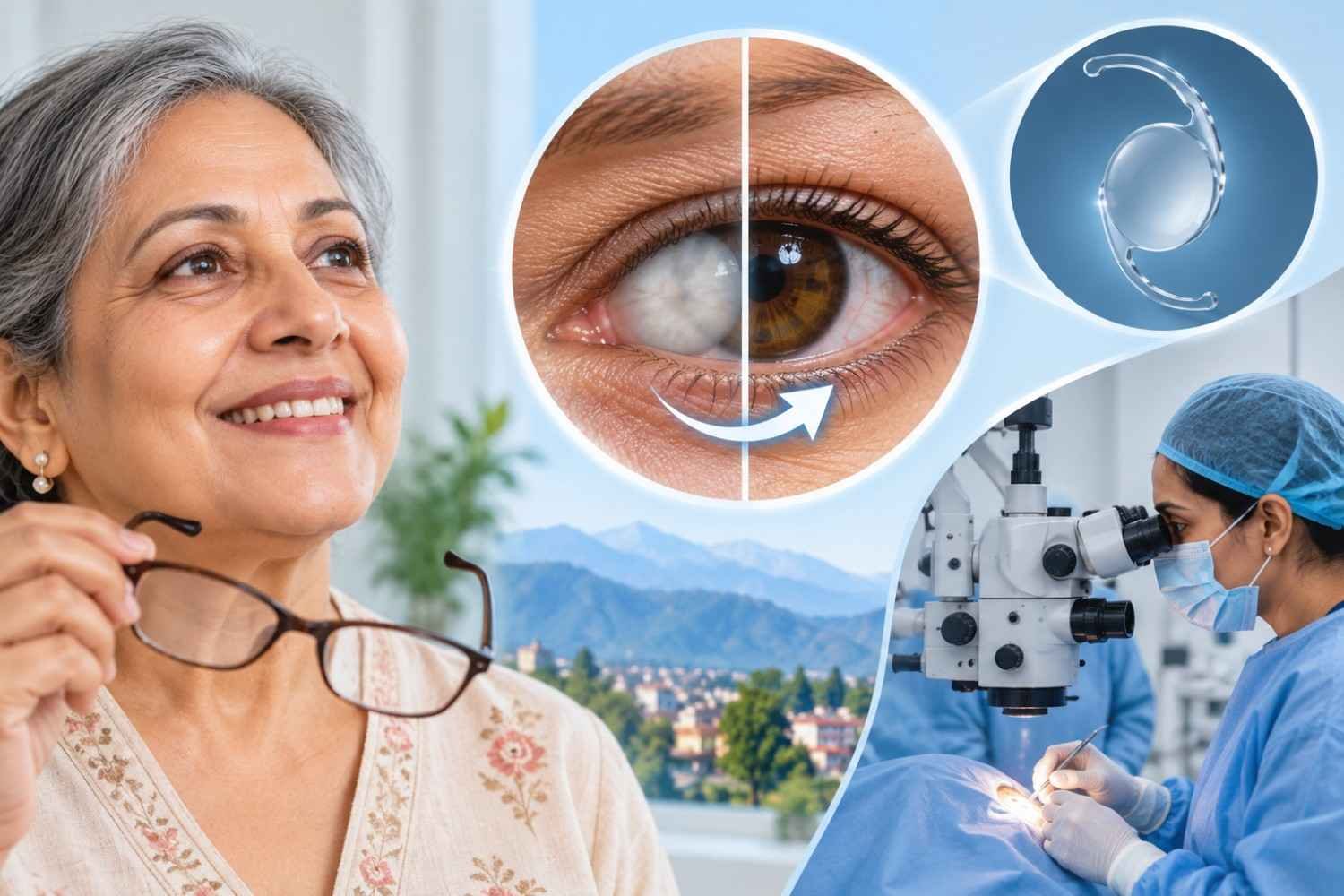
Imagine waking up on a Sunday morning in Dehradun, reaching for your spectacles on the bedside table — and then realising you do not need them. You can see the clock clearly. The garden outside the window. The face of the person next to you. All of it, without glasses.
For most people who have worn spectacles for decades, this image sounds too good to be true. But for thousands of cataract patients across India every year, it is not a dream — it is the outcome of spectacle-free cataract surgery with a premium intraocular lens.
Cataract surgery has always restored clarity — removing the cloudy lens that blurred vision. But the question of whether you need glasses after surgery depends entirely on which replacement lens is used. A standard monofocal lens gives excellent distance vision but leaves you reaching for reading glasses for the rest of your life. A premium trifocal or EDOF lens is designed to eliminate or dramatically reduce that dependence — giving your eyes a range of focus that approaches what they had decades ago.
This guide explains exactly what spectacle-free cataract surgery involves, who is a good candidate, what the realistic outcomes are, and how Dr. Isha Agarwalla at Raahi Netradham in Dehradun makes this option available to patients across Uttarakhand.
Interested in Spectacle-Free Cataract Surgery in Dehradun?
Dr. Isha Agarwalla (FAICO) | Premium IOLs | Optical Biometry | NABH Accredited | Raahi Netradham
Book Your Eye Consultation in Dehradun
Get comprehensive eye care at Raahi Netradham with fellowship specialists, advanced diagnostics, and in-house treatment facilities.
What We'll Cover
- • Why spectacle freedom after cataract surgery is now genuinely possible
- • The spectacle-free journey — what changes after surgery
- • The two lenses that make spectacle freedom possible — trifocal and EDOF
- • Who is the ideal candidate — the 7 criteria
- • Who should not choose a premium IOL
- • What realistic spectacle freedom looks like — day by day
- • Neuroadaptation — why the first months require patience
- • The role of precise biometry — why accuracy is everything
- • Spectacle-free cataract surgery at Raahi Netradham, Dehradun
- • FAQs — answered honestly
The Numbers That Matter
Studies on modern trifocal IOLs consistently show that 85–95% of patients achieve distance visual acuity of 6/9 or better without glasses. Over 80% achieve functional near vision without glasses. Most patients rate their spectacle dependence as 'rarely' or 'never' for daily tasks. These are published clinical outcomes from peer-reviewed studies across thousands of patients.
Why Spectacle Freedom After Cataract Surgery Is Now Genuinely Possible
For most of modern cataract surgery's history — from the 1970s through to the early 2000s — spectacle freedom was not a meaningful goal. Standard monofocal IOLs were optimised for one focal distance, and patients were expected to wear glasses for any distance that lens did not cover. This was accepted as the standard outcome.
What changed was the development of premium multifocal, and later trifocal and EDOF, intraocular lenses — lenses engineered to distribute light across multiple focal zones simultaneously, allowing the brain to use the appropriate focal signal for each viewing distance. Combined with the precision of optical biometry — which allows IOL power calculation to within fractions of a dioptre — the outcomes achievable today are genuinely different from what was possible even fifteen years ago.
The critical word is 'functional' — spectacle-free cataract surgery does not promise laser-perfect 6/6 vision at every distance in every light condition. It promises a range of clear, comfortable, usable vision that covers the vast majority of what patients do every day — and for most patients, that is more than enough to make spectacles irrelevant to their daily life.
The Spectacle-Free Journey — What Actually Changes After Surgery
Patients who are considering premium IOL surgery often ask what daily life actually feels like after spectacle-free cataract surgery. Here is an honest picture, grounded in what Raahi Netradham's patients consistently report:
What becomes effortlessly clear
- Television and cinema: Distance vision is typically excellent within days of surgery
- Driving in daylight: Most patients drive without glasses within 1 to 2 weeks of surgery
- Recognising faces and reading signs: Immediate improvement
- Using a smartphone: Readable without glasses for most patients within weeks
- Computer and tablet use: Good intermediate vision within the first month
- Reading books, newspapers, and menus: Functional within weeks, improving over months
- Navigating outdoors: Steps, distances, paths — immediate clarity
What may still occasionally need glasses
- Very fine print in poor light: A medicine bottle label in a dimly lit room may benefit from a low-power reader
- Extended close work for hours: Some patients prefer low-power readers for prolonged needlework or detailed crafts
- Driving at night in the first 2–4 months: Halos around headlights during neuroadaptation may require caution
The Honest Reality
Spectacle-free cataract surgery does not promise 100% glasses elimination in all circumstances — no honest surgeon should make that claim. What it reliably delivers, in good candidates with accurate biometry, is a life where spectacles are an occasional tool rather than a daily necessity. Most patients describe the change as transformative. Very few describe it as disappointing — when they were properly counselled beforehand.
The Two Lenses That Make Spectacle Freedom Possible
Option A — Trifocal IOL
The Gold Standard for Spectacle Independence
A trifocal IOL divides incoming light into three focal zones — distance, intermediate (50–70cm), and near (30–40cm) — allowing clear vision at all three without glasses. The brain learns to select the appropriate focal signal for each viewing distance within weeks of surgery.
- Distance vision: Typically 6/6 to 6/9 without glasses within days
- Intermediate vision: Computer screen, dashboard, face-to-face conversation — excellent
- Near vision: Smartphone, newspaper, menu — functional to excellent
- Best choice for: Patients who want maximum spectacle independence across all distances
- Consideration: Halos around lights at night in the neuroadaptation period — typically 2–4 months
Option B — EDOF IOL
The Smooth Range Without Halos
An EDOF (Extended Depth of Focus) IOL does not create discrete focal points. Instead, it extends and elongates the range of clear vision — from far distance to intermediate — as a continuous, seamless range. Near vision is functional but somewhat reduced compared to trifocal, typically requiring low-power readers for very fine print.
- Distance vision: Excellent, comparable to trifocal
- Intermediate vision: Excellent — smooth, natural, no jumps between focal zones
- Near vision: Functional; some patients need +1.0 to +1.5D readers for fine print
- Best choice for: Patients who want excellent distance and screen with minimal halos — ideal for frequent night drivers
- Advantage over trifocal: Significantly fewer halos and glare in low-light conditions
| Spectacle-Free Goal | Better Lens Choice |
|---|---|
| Complete independence — distance, screen AND book without glasses | Trifocal IOL |
| Distance and screen freedom — low-power readers acceptable for fine print | EDOF IOL |
| Frequent night driving — minimal halos essential | EDOF IOL |
| Maximum near vision — regular reading is a priority | Trifocal IOL |
| Smooth, natural vision range — no 'zones' | EDOF IOL |
| Best overall spectacle freedom for daily life | Trifocal IOL |
For patients with significant astigmatism (cylinder in spectacles above 1 dioptre), toric variants of both lenses are available — the toric trifocal and toric EDOF — which correct both the cataract and astigmatism simultaneously, maximising the chance of spectacle independence.
Who Is the Ideal Candidate — The 7 Criteria
Spectacle-free cataract surgery delivers outstanding results in the right patients. Identifying those patients accurately is the most important step in the process — and it is what the pre-operative assessment at Raahi Netradham is specifically designed to determine.
Criterion 1 — Healthy Macula on OCT
Premium IOLs require a healthy macula to perform optimally. The trifocal lens distributes light across multiple zones — which works beautifully when the macular photoreceptors are intact but is compromised by existing macular disease. All patients considering a premium IOL have an OCT at Raahi Netradham before any lens recommendation is made. Patients with diabetic macular oedema, age-related macular degeneration, epiretinal membrane, or other macular pathology are counselled accordingly — and often steered toward a monofocal lens instead.
Criterion 2 — Regular Corneal Topography
The cornea must be regular — no keratoconus, no significant scarring, no irregular astigmatism — for a premium IOL to deliver predictable, high-quality optics. Corneal topography is performed at Raahi Netradham before any trifocal or EDOF recommendation. Irregular corneas distort the wavefront in ways that premium lenses cannot fully compensate, reducing the quality of vision.
Criterion 3 — Controlled Dry Eye
Dry eye disease is one of the most common causes of suboptimal premium IOL outcomes. An unstable tear film produces a fluctuating visual quality that degrades the optical performance of any lens, but particularly premium lenses which are more sensitive to optical aberrations. Patients with significant dry eye are treated before surgery — with lubricating drops, anti-inflammatory drops, and lid hygiene — and reassessed before proceeding with a premium lens.
Criterion 4 — No Advanced Glaucoma
Advanced glaucoma with significant visual field loss reduces contrast sensitivity — which is already slightly lower with trifocal IOLs than with monofocal. The combination can result in vision that is technically measurable but functionally disappointing. Patients with well-controlled, early glaucoma and minimal field loss can still be premium IOL candidates; those with advanced disease are counselled toward monofocal lenses.
Criterion 5 — Realistic Expectations
This is the criterion that is hardest to measure — and the most important for patient satisfaction. Patients who understand that neuroadaptation takes 2–4 months, that some halos in low light are normal initially, and that very fine print in poor light may occasionally need a reader — these patients are overwhelmingly satisfied with their premium IOL outcome. Patients who expect perfect vision on Day 1 in all conditions, without any adaptation period, are at risk of disappointment even when the clinical outcome is excellent.
Criterion 6 — Motivation for Spectacle Freedom
Premium IOLs cost more than standard monofocal lenses. For a patient who is genuinely comfortable wearing reading glasses and has no strong motivation to be glasses-free, the additional investment may not be justified. Dr. Isha assesses how much spectacle dependence actually bothers each patient — and recommends accordingly. A patient who has happily worn reading glasses for 20 years may be better served by a monofocal lens and preserved budget than by a premium lens they did not strongly want.
Criterion 7 — No Previous Corneal Refractive Surgery (or appropriately managed)
Previous LASIK, PRK, or LASEK alters the corneal curvature in ways that reduce standard IOL formula accuracy. Premium IOLs can still be used after previous refractive surgery, but require specialised biometry formulae and careful patient counselling on slightly higher residual error risk. Dr. Isha uses enhanced formulae (Barrett True-K, Haigis-L) for all post-refractive surgery patients and adjusts outcome expectations accordingly.
Who Should Not Choose a Premium IOL for Spectacle Freedom
Being honest about who is NOT a good candidate is the mark of a surgeon focused on outcomes rather than upselling. Dr. Isha Agarwalla recommends a standard monofocal lens — without hesitation — for patients who fall into the following categories:
| Patient Type | Why Premium IOL Is Not Recommended | What Is Recommended Instead |
|---|---|---|
| Significant macular disease (AMD, DMO, ERM) | Macular pathology limits the visual quality premium IOLs depend on | Monofocal IOL — maximise safety; treat macular condition separately |
| Irregular cornea / keratoconus | Corneal irregularity degrades premium optic performance unpredictably | Monofocal IOL; manage corneal condition first |
| Severe dry eye (untreated) | Unstable tear film degrades all premium optic quality | Treat dry eye first; reassess in 3–6 months |
| Night truck / lorry driver who cannot tolerate any halos | Even EDOF produces some halos initially; safety concern | Monofocal IOL set for distance — safest for occupational night drivers |
| Advanced glaucoma with field loss | Reduced contrast sensitivity makes halos unacceptably troublesome | Monofocal IOL — prioritise glaucoma stability |
| Patient who does not mind glasses | Premium IOL cost not justified if motivation absent | Monofocal IOL — excellent result at lower cost |
| Very high anxiety about halos — not manageable by counselling | Difficulty adjusting to temporary visual phenomena during neuroadaptation | Monofocal IOL — predictable optical profile without dysphotopsia |
Spectacle-Free Cataract Surgery at Raahi Netradham, Dehradun
Raahi Netradham on Haridwar Bypass Road is one of Uttarakhand's very few NABH-accredited eye hospitals offering the full range of premium IOL options for spectacle-free cataract surgery — without patients needing to travel to Delhi.
| What Is Available for Spectacle-Free Surgery at Raahi Netradham | |
|---|---|
| Trifocal IOL | AT LISA tri, PanOptix, and equivalent premium trifocal platforms |
| Toric Trifocal IOL | Combined astigmatism correction + trifocal optics for spectacle freedom |
| EDOF IOL | Symfony, Vivity, and equivalent — smooth range, fewer halos |
| Toric EDOF IOL | Astigmatism correction + extended depth of focus combined |
| Optical Biometry | IOL Master — in-house, every pre-operative assessment, no additional visit |
| Corneal Topography | In-house — essential for toric IOL axis marking and corneal quality assessment |
| OCT Macula Assessment | In-house — confirms macular health before premium IOL recommendation |
| Pre-Op Dry Eye Assessment | Tear break-up time and corneal staining — identifies patients needing treatment before surgery |
| Post-Op Neuroadaptation Support | Dr. Isha and team available throughout the adaptation period — call, WhatsApp, or clinic visit |
| YAG Laser for PCO | In-house — if posterior capsule opacification develops months to years after surgery, treated in-clinic |
| Surgeon | Dr. Isha Agarwalla — MBBS, DNB, FAICO, MNAMS |
| NABH Accreditation | Certified OT — documented sterility, safety, and quality protocols |
Patients from Mussoorie, Haridwar, Rishikesh, Tehri, Roorkee, Vikasnagar, and across the Garhwal-Kumaon region regularly choose Raahi Netradham for spectacle-free cataract surgery — because the same quality of premium IOL care available at Delhi's top hospitals is available 60 minutes from Mussoorie and 50 minutes from Haridwar, at an NABH-accredited facility, with a fellowship-trained surgeon.
Book Your Spectacle-Free Cataract Consultation at Raahi Netradham
NABH Accredited | Full Premium IOL Range | Optical Biometry | Dr. Isha Agarwalla (FAICO)
Monday – Saturday, 9 AM – 6 PM | Haridwar Bypass Rd, Ajabpur Kalan, Dehradun 248012