
Schedule Your Visit
Fill out the appointment form and our team will contact you shortly.
Squint Eye (Strabismus): Symptoms, Causes & Treatment — A Guide for Patients in Dehradun
Most parents notice it in a photograph first. One child's eye is looking straight at the camera while the other is drifting inward, outward, or slightly upward. Sometimes a teacher notices it at school, or a grandparent visiting from Mussoorie says, "Bachche ki aankh thodi alag lagti hai."
Squint eye—medically known as strabismus—is one of the most common eye conditions in children, affecting nearly 1 in 25 children across India. Unfortunately, many parents assume their child will outgrow it or believe it is too minor to require treatment.
The reality is different. Children do not outgrow squint eye on their own. Without timely treatment, the brain gradually starts ignoring the image from the misaligned eye, leading to amblyopia (lazy eye). Once the visual system fully develops—usually by the age of 7 to 8 years—this vision loss can become permanent.
Early diagnosis is therefore essential. With prompt evaluation and appropriate treatment, most children can achieve proper eye alignment, healthy visual development, and improved depth perception. Adults with squint can also benefit from modern treatment that enhances both vision and appearance.
This guide explains what squint eye (strabismus) is, its common symptoms, underlying causes, diagnostic tests, and the latest treatment options available for both children and adults in Dehradun and across Uttarakhand.
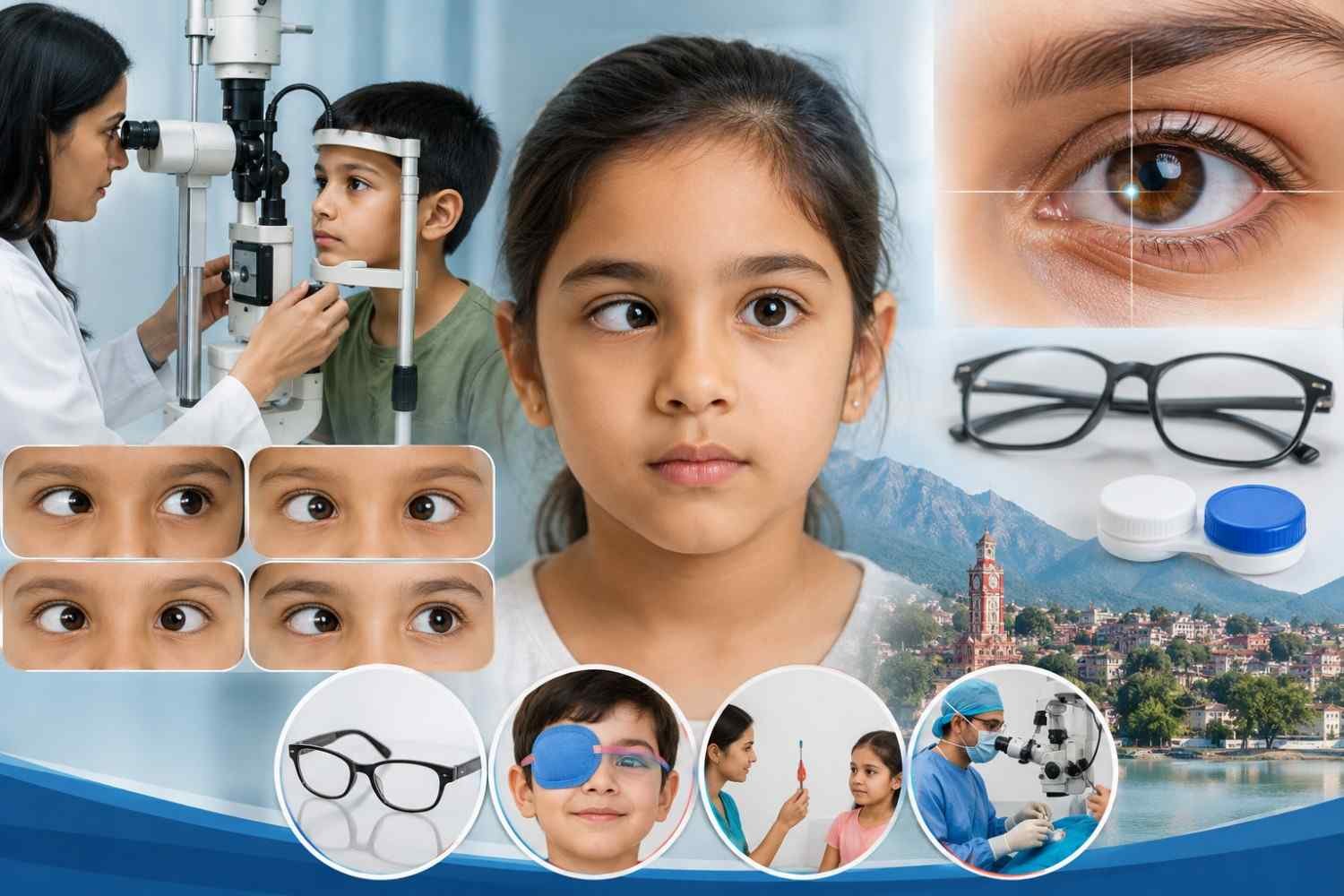
Noticed Your Child's Eye Turning In or Out?
Early evaluation makes all the difference. Visit Raahi Netradham, a NABH-accredited eye hospital in Dehradun, for expert diagnosis and personalized treatment for Squint Eye (Strabismus) in children and adults.
What We'll Cover
This comprehensive guide explains everything parents and patients in Dehradun need to know about Squint Eye (Strabismus)—from understanding why it happens to the latest treatment options available for children and adults.
- • What is squint eye—and what is actually happening?
- • Types of squint—the different ways eyes misalign
- • Symptoms—what parents and patients notice
- • Causes—why squint develops
- • The link between squint and amblyopia (lazy eye)
- • When is it urgent? Red flags to act on immediately
- • How squint is diagnosed in Dehradun
- • Treatment options—glasses, patching, exercises, and surgery
- • Squint in adults—is it treatable?
- • Squint surgery—what to expect at Raahi Netradham
- • Frequently Asked Questions (FAQs)
What Is Squint Eye — And What Is Actually Happening?
Normally, both eyes work together with the help of six muscles in each eye, allowing the brain to create a single, clear image. In Squint Eye (Strabismus), this coordination is disturbed, causing one eye to turn inward, outward, upward, or downward while the other continues looking straight ahead.
The Critical Insight
Young children with squint usually do not complain of double vision because the brain automatically ignores the image from the weaker eye. If left untreated, this suppression can lead to amblyopia (lazy eye), resulting in permanent vision loss.
Early eye screening before the age of 5 is the best way to detect squint early and protect your child's long-term vision.
Types of Squint — The Different Ways Eyes Misalign
Not all squints look or behave the same way. Understanding the type of squint helps doctors choose the most appropriate treatment.
Common Types of Squint Eye (Strabismus)
Squint eye can appear in different forms depending on the direction of eye misalignment, whether it is constant or occasional, and whether it is caused by muscle imbalance or nerve problems.
| Type | Direction of Turn | Common Name | Common In |
|---|---|---|---|
| Esotropia | Eye turns inward toward the nose | Convergent squint / Cross-eye | Most common type; often linked to farsightedness |
| Exotropia | Eye turns outward toward the ear | Divergent squint / Wall-eye | Common; often more noticeable during fatigue or bright sunlight |
| Hypertropia | Eye turns upward | Vertical squint | Less common; may cause abnormal head posture |
| Hypotropia | Eye turns downward | Downward squint | Often associated with cranial nerve disorders |
| Intermittent | Eye drifts only occasionally | Intermittent exotropia | Very common; worsens with illness, stress or fatigue |
| Constant | Eye remains misaligned all the time | Constant strabismus | Requires early treatment due to higher amblyopia risk |
| Concomitant | Same angle in every direction of gaze | Common childhood squint | Usually related to eye muscle imbalance |
| Incomitant (Paralytic) | Angle changes with eye movement | Paralytic squint | May indicate nerve palsy or muscle restriction and needs neurological evaluation |
The appearance of a squint does not always indicate its severity. Even a mild or occasional eye turn can affect normal visual development in children. Early evaluation by a Squint Eye Specialist in Dehradun helps prevent complications such as amblyopia (lazy eye) and improves long-term visual outcomes.
Symptoms — What Parents and Patients Notice
Squint (strabismus) symptoms vary depending on age and the type of eye misalignment. While children often do not complain because their brain adapts, adults usually notice vision-related problems. Recognizing these signs early can help prevent long-term vision complications.
In Children
- One eye visibly turning inward, outward, upward, or downward
- Closing or covering one eye in bright sunlight
- Tilting the head to one side for clearer vision
- Squinting or frowning while looking at distant objects
Additional Signs in Children
- Poor depth perception and difficulty judging distances
- Missing objects on one side due to visual suppression
- One eye appearing smaller or larger because of its position
- Eye turn noticed by family members in photographs
In Adults
- Sudden or gradually developing double vision (diplopia)
- Eye strain, fatigue, or headaches while reading
- Difficulty judging distances while driving or using stairs
- A noticeable eye turn affecting confidence or daily activities
When Symptoms Become More Noticeable
- One eye drifting when tired or unwell
- Eye deviation becoming more obvious after alcohol or prolonged visual work
- Difficulty maintaining comfortable binocular vision
- Persistent vision discomfort requiring specialist evaluation
Meet Dr. Isha Agarwalla — Dehradun's Cataract Specialist at Raahi Netradham
Fellowship-trained Cataract Surgeon, Oculoplastic Specialist & Ocular Oncologist providing advanced cataract care with personalised treatment at Raahi Netradham Eye Clinic, Dehradun.

Dr. Isha Agarwalla
Cataract Surgeon, Oculoplastic Specialist & Ocular Oncologist
Dr. Isha Agarwalla is Dehradun's fellowship-trained cataract and oculoplastic surgeon at Raahi Netradham Eye Clinic—one of Uttarakhand's very few NABH-accredited eye hospitals. She holds an MBBS, DNB in Ophthalmology, FAICO (Fellow of the All India College of Ophthalmologists), and is a proud Member of the National Academy of Medical Sciences (MNAMS).
She performs advanced phacoemulsification cataract surgery using the complete range of intraocular lens (IOL) options, including monofocal, trifocal, toric, and EDOF premium lenses for patients seeking excellent vision and greater spectacle independence after surgery.
Every patient undergoes a comprehensive pre-operative assessment, including optical biometry, corneal topography, and retinal evaluation, ensuring the most suitable lens is selected for their lifestyle and visual needs.
Modern Micro-Incision Technique
Monofocal, Toric, Trifocal & EDOF
Biometry, Topography & Retina Check
Raahi Netradham Eye Clinic
Causes — Why Squint Eye Develops
Squint (strabismus) can develop due to a variety of eye, muscle, nerve, or neurological conditions. Identifying the underlying cause is essential for choosing the most effective treatment and preventing long-term vision problems.
Common Causes in Children
- Uncorrected farsightedness (hyperopia) leading to accommodative esotropia
- Family history of squint or other eye alignment disorders
- Premature birth increasing the risk of visual and neurological problems
- Developmental conditions such as cerebral palsy or Down syndrome
Additional Childhood Factors
- Eye injuries, congenital cataracts, or retinal diseases
- Poor vision in one eye causing eye misalignment
- Congenital muscle imbalance affecting eye movements
- Idiopathic cases where no specific cause is identified
Common Causes in Adults
- Cranial nerve palsy affecting eye muscle movement
- Diabetes, high blood pressure, stroke, or aneurysm
- Thyroid eye disease (Graves' orbitopathy)
- Orbital trauma or fractures restricting eye movement
Other Adult Causes
- Brain or orbital tumours affecting eye alignment
- Myasthenia gravis causing weakness of eye muscles
- Decompensated childhood squint becoming noticeable later in life
- Eye deviation worsening with illness, stress, or fatigue
The Link Between Squint and Amblyopia (Lazy Eye)
Early treatment of squint is essential because prolonged eye misalignment can prevent normal vision development and lead to amblyopia (lazy eye).
How Squint Leads to Lazy Eye
When one eye is misaligned, the brain receives two different images. In young children, the brain adapts by suppressing the image from the misaligned eye to avoid double vision. Over time, this becomes a permanent habit, and the visual pathway from that eye fails to develop normally.
This condition is known as amblyopia (lazy eye). The eye itself may be healthy, but the brain has learned to ignore its signals, resulting in permanently reduced vision if treatment is delayed.
| Age When Treatment Starts | Expected Outcome for Amblyopia |
|---|---|
| Before 3 Years | Excellent – Visual system is highly adaptable and full vision recovery is often possible. |
| 3–5 Years | Very Good – Most children respond well to glasses, patching, and appropriate treatment. |
| 5–7 Years | Good – Significant improvement is still achievable with consistent treatment. |
| 7–9 Years | Partial – Some vision improvement is possible, but response gradually decreases. |
| After 9–10 Years | Limited – Vision loss from amblyopia is largely permanent, although squint treatment can still improve eye alignment and appearance. |
Every month of delay during early childhood reduces the opportunity for normal visual development. If your child has a squint, seek evaluation by a Squint Eye Specialist in Dehradun as early as possible. Timely treatment offers the best chance of preventing amblyopia (lazy eye) and achieving healthy binocular vision.
Treatment Options — Glasses, Patching, Exercises & Surgery
Squint (strabismus) treatment is personalized for every patient. The ideal treatment depends on the type of squint, its underlying cause, the patient's age, and whether amblyopia (lazy eye) is present. In many cases, the best results are achieved through a combination of treatments.
Corrective Glasses
- First-line treatment for accommodative esotropia caused by farsightedness.
- Reduces eye strain and often straightens the eyes without surgery.
- Children usually need to wear glasses full-time for the best results.
- Prescriptions are updated regularly as the child's vision develops.
Patching & Atropine Therapy
- Patching strengthens the weaker eye in children with amblyopia.
- Patching is done for prescribed hours each day with regular follow-up.
- Atropine eye drops are an effective alternative for children who cannot tolerate patches.
- Both treatments encourage normal visual development during childhood.
Eye Exercises & Prism Glasses
- Orthoptic exercises improve coordination between both eyes.
- Useful for intermittent squint and convergence insufficiency.
- Prism glasses reduce double vision in selected adult patients.
- Often combined with other treatments for optimal outcomes.
Squint Surgery
- Recommended when glasses or exercises cannot fully correct eye alignment.
- Adjusts the eye muscles to restore proper alignment.
- Performed under general anaesthesia in children and local/general anaesthesia in adults.
- Improves eye alignment, binocular vision, and cosmetic appearance.
Early Treatment Gives the Best Results
Early diagnosis and timely treatment provide the highest chance of restoring normal eye alignment and preventing permanent vision loss from amblyopia. Regular follow-up with a squint specialist ensures that treatment is adjusted as your child's vision develops.